



Environmental aspects of the global trade in foodstuffs.
The potential for sustainable food supplies.
Post World War 2 saw a massive intensification of agriculture in the
Western world, and these intensive industrial farm practises have spread
globally through the transfer of technology, the emergence of new
farming superpowers such as
However, this globalisation
of farming, the use of the free market and the transport of food over
great distances has huge consequences for the environment.
In many ways modern industrial farming is unsustainable, and the
search for sustainability in farming is on.
This also has to balance with the need to feed an ever increasing
number of people as population increases, can we avoid a Malthusian
catastrophe? Remember
Sustainable Development as a concept means
"development that meets the needs
of the present (generations) without compromising the ability of future
generations to meet their own needs."
(Brundtland commission 1983)
The idea would be that humans do not exceed the carrying capacity of the
Earth, and that in the context of food supply we produce our food in a
manner that nourishes all of the people on planet Earth well without
limiting future generations ability to feed themselves by using up
natural resources or damaging the environment we use to produce our
food.
We need to appreciate that there needs to be availability of food to an
appropriate level for the population should be secure, long term and
without causing damage to the environment.
This poses huge
issues, because our current method of agricultural production to meet
food supply poses the following environmental problems;
Food miles
Food miles are a basic way of
showing how far our food travels to get to us.
The amount of food miles is increasing for each family in the
The graphic below shows this point
well;

Carbon
footprint
Food miles therefore contribute to the carbon footprint of our food.
The transport types used output huge quantities of greenhouse
gasses such as Carbon Dioxide and Nitrous Oxides.
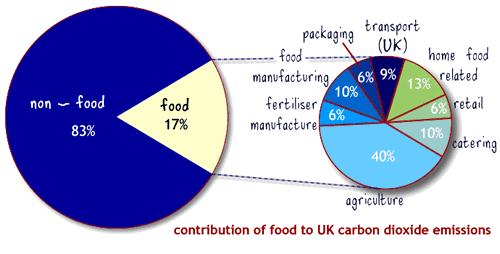
However, transport is only part of the carbon footprint of our
food and this has a direct impact on our environment.
Other items produce carbon dioxide, including packaging,
especially plastic packaging, the retail spaces that sell our food (in
the form of their electricity use, heating, refrigeration etc),
agricultural production of carbon, food use etc.
This is wonderfully demonstrated on the graph below.
Use of
chemical fertilisers
Fertilisers enhance soil
chemistry by introducing nutrients deficient in or lacking in soils.
Fertilizers often contain a mixture of nitrogen, phosphorus and
potassium in varying quantities, depending on the application. All of
these chemicals occur naturally in the environment.
They can have a negative impact upon the environment.
When excess nitrites and nitrates enter aquatic or water
ecosystems, an increase in the ammonia cycle occurs resulting in
excessive ammonia in the water, which can kill aquatic plants and
organisms. In addition, excessive phosphorus in aquatic ecosystems causes algal
blooms, which in turn create a cycle whereby dissolved oxygen is
depleted, resulting in plant and fish kills.
Use of
chemical pesticides, fungicides and insecticides
Pesticides, fungicides and insecticides are used to control those organisms
that cause damage to agricultural products and would lower yields if
left unchecked. Many
chemicals are also sprayed, and this means that many of these chemicals
end up in a location other than the intended destination.
Over 98% of sprayed insecticides and 95% of herbicides reach a
destination other than their target species, including non-target
species, air, water, bottom sediments, and food.
Pesticides can also contaminate unintended land and water when
they are sprayed aerially or allowed to run off fields, or when they
escape from production sites and storage tanks or are inappropriately
discarded. Many of these
chemicals are persistent soil contaminants, and pesticides have also
been strongly linked with the decline of the Honey bee.
Birds have also suffered, and it is estimated that
populations of ten different bird species declined by 10 million
breeding individuals between 1979 and 1999, a phenomenon thought to have
resulted from loss of plant and invertebrate species on which the birds
feed. A good example of this is
Juazeiro, Bahio state.
This is one of the driest parts of
Crude oil is required in many ways in agriculture, from the obvious use in
farm machinery to the production of chemical fertilisers and pesticides.
Much of our agriculture is reliant on a non renewable resource,
rendering it unsustainable in the long term.
Soils are impacted by having to absorb persistent chemical use and by over
use. We have witnessed a
decline in Organic matter caused by intensive farming, drainage of
carbon-rich soil (e.g. peat and wetlands), soil erosion and climate
change. Soils also have
reduced biodiversity because of chemical use, and fertility falls
because of reduced vegetation cover and being used to grow the same crop
over and over again.
Many countries have extended the amount of land they farm
by colonising new parts of their countries.
This is often to the cost of the natural environment and
ecosystems. Rich nations
like the
Ghost
acres and monocultures
Ghost acres relate to those acres of land in poorer countries that are used
for the production of export crops.
They are “ghost” acres because for an often undernourished
population in an LEDC the land is unavailable to produce food for that
local population. The term
ghost acres was coined in
Intensive agriculture consumes huge amounts of water.
In the
There are alternatives in the hunt for more sustainable
agriculture, and perhaps we are ready for a revolution in the way we
produce and consume food globally.
Sustainable agriculture relates to the ability of farmers to
produce food indefinitely without causing damage to the local
environment. The concept of
Sustainable food supplies are wider in definition, including sustainable
agriculture but also considering the transport issue as well.
Pressure group
Sustain says food should be produced, processed and traded in ways
that:
, and Contribute to thriving local economies and sustainable
livelihoods at home and abroad
Protect the diversity of
plants and animals and avoid damaging natural resources and contributing
to climate change
Provide social benefits, such as good quality food, safe and
healthy products and educational opportunities
Some ideas for improving sustainability include;
Organic
The Soil Association certifies 70% of the
There are alternatives to pesticides.
Biological control is an alternative to using pesticides. By releasing a
natural predator into the crop growing area, the number of pests
can be reduced. However, this can have unforeseen consequences as the numbers of
different organisms in the food web are changed. There have been
examples of the predator becoming a more serious pest than the original
problem. An example of
Biological control
is the introduction of the small wasp, Trichogramma ostriniae, was introduced from
Local food
sourcing, eating seasonally and grow your own
There is a growing movement in the
Local food sourcing comes in other ways too.
Local food stores have pushed local food produce as a counter
measure against the internationalism of the supermarkets.
Farmers markets have also become popular, where farmers from
local areas get together to sell their produce direct to the consumer
and cut out the retailers.
There is also direct marketing, where farmers get together to deliver
food boxes to your door.
Stewardship
Environmental Stewardship (ES) is an agri-environment
scheme which offers payments to farmers and land managers in
The scheme’s primary objectives are to:
-
Conserve wildlife (biodiversity)
-
Maintain and enhance landscape quality and character
-
Protect the historic environment
-
Protect natural resources (water and soil)
-
Promote public access and understanding of the countryside
There are also secondary objectives for genetic
conservation (rare breeds), flood risk management, and an overarching
objective to contribute to climate change adaptation and mitigation.
Nearly 6.5 million hectares (nearly 70% of
The use of
biotechnology
Selecting and developing plants with tolerance to pests can reduce the use
of pesticides. A study found
that
where farmers plant biotech soy, corn, cotton or
canola, pesticide use has fallen by 286 million kg, or 7.9 percent. The
reductions come from herbicide-tolerant traits and insect-protection
traits that reduce the number of pesticide applications required by
farmers to grow their crops. (source).
You can read more on
biotechnology here.
Fair trade falls into the category of sustainability because it is concerned
with improving the lives of people socially by guaranteeing a reasonable
price for their produce. The
fair trade scheme also has elements of good practices towards the
environment within it.

Improving farming in poorer countries can reduce the need to import and
there fore transport food.
The use of appropriate technology can achieve this and you can read more
about this strategy
here.
Find out more from the
Food and
Agriculture Organization of the United Nations.