



Environmental aspects of the global trade in foodstuffs.
The potential for sustainable food supplies.
Globalisation of Food supply
"For people who want to buy corn, there really isn't much choice but to come to us.’"
Bob Kohlmeyer, former
manager, Cargill corporation
-
foods that cannot be grown in the UK because of our temperate
climate (e.g. bananas, pineapples, lemons),
-
foods that cannot be grown in sufficient quantity to meet demand
(e.g. we can produce sugar in the UK using sugar beet but still
have to import lots of sugar from tropical areas from sugar cane
to meet demand),
-
foods that can be grown in other countries when they are not in
season in the UK (e.g. apples in winter) and;
- foods that can simply be produced cheaper elsewhere because the producer has a competitive advantage in some way (e.g. cheaper labour in LEDCs such as Kenya, economies of scale in places with large landmasses such as grain production in the Prairies of North America, specialisation in places such as Mangoes in Brazil).
T

This is the concept or phenomenon of the
globalisation of food production and consumption, and it is not exclusive to the
UK but reaches into the heart of every continent.
Principally, at the heart of the globalisation of food and consumption is
the FREE MARKET ECONOMY that has evolved over time and consumer demand in MEDCs,
plus the need for countries to gain export income from cash crops.
This is not a new idea, and trade in food stuffs has occurred for many
centuries including the Spice trail of the 15th Century which brought
pepper, vanilla and nutmeg to Europe, the triangular trade which involved moving
industrial goods from Europe to West Africa, slaves from West Africa to the
Americas and finally plantation goods such as tobacco and sugar back to Europe
(16th to 19th centuries), and tea from India to the UK
(through the East India Company) as notable examples.
Indeed, many things have fuelled and allowed the globalisation of food
including;
-
the ever increasing demand in MEDCs for non seasonal produce
(e.g. Strawberries in Winter),
-
consumer diets changing,
-
the impact of migration widening diets and knowledge of global
food types
-
the availability of multimedia such as the Internet and
television broadening peoples culinary horizons
-
the increasing availability of exotic food stuffs
-
the improvement in productivity in farming in LDCs and LEDCs
-
improvements in transport technology and the expansion of trade
routes
-
huge advances in the preservatives industry
-
the development of huge Trans National Corporations controlling
the supply chain
- the demands and influence of major retailers in the UK – including the supermarkets
TNCs
Trans National Corporations are huge in food supply. This can be seen on this page. Action Aid published a brilliant document that showed that TNCs are controlling an ever increasing share of production and wield ever greater power in the following ways;
1) Seed and agrochemicals
• Six TNCs –
BASF, Bayer, Dow, DuPont,
Monsanto
and
Syngenta
– now control 75-80% of
the global pesticides market, down from 12 corporations in 1994.
•
DuPont
and
Monsanto
together dominate the world seed markets for maize (65%), and soya
(44%).
•
Monsanto
controlled 91% of the global genetically modified (GM)
seed market
in 2001 and took over 60% of the Brazilian non-GM maize
seed market in the space
of two years (1997-1999).
•
Bayer
controls 22% of the Indian pesticide market.
2) Bulk commodity trading
• Two US TNCs,
Chiquita
and
Dole Foods,
control almost 50% of the world trade in bananas.
•
Archer Daniels Midland
(ADM), Barry Callebaut
and
Cargill
dominate Côte d’Ivoire’s
cocoa processing industry, where 95% of processing capacity is controlled by
TNCs.
•
Fyffes,
the largest fresh produce distributor in Europe, is the sole
exporter of bananas from Belize and Surinam.
• Three companies –
ADM, Cargill
and
Zen Noh
– handle over 80% of US corn exports.
3) Food manufacturing and
processing
• The top ten food processing companies account for 37% of sales by
the largest 100 companies in the industry.
• Three companies control 85% of the world’s tea market, and
Unilever
is the world’s biggest tea
supplier.
•
Nestlé
has established a virtual monopoly of the UHT milk market in
Pakistan, and controls around 80% of Peru’s milk production.
• Four companies, including
Cargill
and
Tyson, control 81% of the US beef packing industry.
4) Food retailing
• The 30 largest food retailing corporations account for around
one-third of all world grocery sales, with the top 10 amassing combined sales of
US$649 billion in 2002.
•
Wal-Mart
controls 40% of Mexico’s retail sector.
• Thirty-six per cent of all food sales in Thailand are now
channelled through TNC retailers, where
Tesco
had 48 outlets and sales of around US$1.2 billion in 2003.
•
Asda Wal-Mart, Safeway, Sainsbury,
and
Tesco
account for 75% of food
sales in the UK.
Source: ActionAid “Power Hungry”

WTO
The World Trade
Organisation are a global organisation that are a major player in the
globalisation of food. They
exist to try and regulate and
control trade, and in this instance that trade is in food stuffs. The origins of
our current system are found in the
Bretton Woods agreement, which sought to reorganise the world post World
War 2. This agreement created the World Bank and International Monetary Fund
(IMF) both based in New York. These 2 organisations lend money to countries in
trouble (as they were across Europe post WW2) but also advise countries on
domestic and trade matters. In addition, the General Agreement of Tariffs and
Trade (GATT) was also instigated to control world trade, to ensure fairness and
to help legally secure trade. This was superseded by the World Trade
Organisation in 1995 - which aims to liberalise (or free up) trade, negotiate
trade agreements and settle trade disputes. The Doha round of WTO talks sought
to reduce the tariffs on imported goods in an attempt to help poorer nations.
However, many MEDCs have benefitted massively from free trade, whilst
many LEDCs have suffered a fall in prices for their primary products.
Trading blocs
The other big political bodies
involved include the G8 and G20 groups of most powerful economies. The heads of
state from these countries meet regularly and also have a huge impact upon the
trade of agricultural goods. It is often argued that these countries exert far
too much influence over the IMF and World Bank, and on the WTO. It is also
argued that they bias the world trade system in their favour. In the past their
have been anti-capitalist protests and even riots aimed at the WTO, the IMF and
the G8/G20. Trading blocs such as
the European Union can promote global trade too, by actively encourageing
production in LEDCs through aid.
This has alos been the case through charitable organisations, such as the
Rockefeller foundation and the Ford foundation.
They established the Rice Research Institute, which led to the green
revolution in LEDCs and promoted commercial agriculture and hence globalisation
above local produce and subsistence farming.
Technology
Technology in food production has advanced
incredibly. Transport has become
more widely available including the use of planes, boats and lorries, whilst
preservation methods have increased too.
Preservation of food basically means to try to stop the growth of yeasts,
fungi, bacteria and micro organisms. Traditional measures such as drying food
and salting have been joined by a staggering number of ways to preserve food
from freezing, to vacuum packing, to irradiation and using modified atmospheres.
These have all allowed food to be kept for longer and to travel longer
distances, thus increasing the globalisation of food production.
Impacts and issues
There are several issues that arise from the globalisation of food
production;
-
Farmers are getting less and less of an
income -
In
the 1950s, of every £1 spent on food and drink 50-60% went to
the farmer. Today, just 9% of every £1 spent on food and drink
goes back to the farmers
-
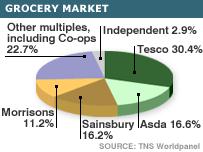
Supermarkets dominate the retail of food in the UK – the major
supermarkets dominate slaes. Tesco, Asda, Morrisons and
Sainsburys dominate over 75% of the UK’s grocery sales
-
Food and drink is the largest manufacturing industry in
the UK at 14% of manufacturing output
-
Food distribution accounts for 40% of all freight transport in
the UK
-
Animals are travelling ever greater distances, making disease
out breaks such as
foot and
mouth (2007) ever more likely
-
Lack of competition allows TNCs to drive down prices.
-
LEDCs have opened up their markets whilst many MEDCs including
the EU used protectionism to protect their farmers
-
Farming has intensified in most countries, leading to the
increased use of chemicals which raise production but which
damage the environment
-
Large tracts of rainforest including in
Brazil have been demolished to make way for farming areas
-
Migrant and seasonal workers have work,
but the conditions are poor
-
Food is travelling further, increasing
carbon footprints and food miles
-
There is pressure on countries to produce
biofuel, but should we produce food or fuel on our land?
-
Ghost acres – these are acres of land given over to export
crops, often in countries where there are food shortages, are
these acres ethical?
-
Cleaning up the chemical pollution, repairing the habitats and
coping with sickness caused by industrial farming costs up to
£2.3 billion a year
-
Animals are reared on production lines with poor animal welfare
standards