



Managing food supply – strategies to increase production: land colonisation and land reform
Land reforms in Zimbabwe
Adapted from “Power and Plunder in Zimbabwe” by Martin Meredith

When Robert
Mugabe gained control of Zimbabwe in 1980 after a long period in jail he really
favoured the white farming community of
Zimbabwe.
Their role was viewed as crucial to the future economic welfare of the
country. They accounted for ¾ of the
output of the agricultural industry and produced a multitude of crops and
commodities using sophisticated techniques and equipment.
They grew;
-
90% of the marketed maize, the main staple and;
-
Nearly all of the tobacco, wheat, coffee tea and sugar produced
for export.
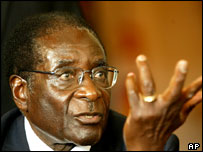
Click on the image for Robert Mugabe's profile
Indeed, white
farmers accounted for 1/3 of total exports, employed 1/3 of the wage earning
workforce in 1980 (271,000 people!)
They number
6,000 and had voted repeatedly for
Ian Smith, the previous president, as he
protected their land ownership rights.
Initially
Mugabe recognised the need to keep white farmers happy, but this changed as he
used them as scapegoats for Zimbabwe’s international and internal problems.
Initially, in
1890, white settlers
arrived looking for gold, but this proved disappointing,
they had to settle for the next best thing – LAND.
Farms were pegged out regardless of whether or not people were already
living there. Early pioneers
allocated land as they pleased, indeed, Cecil Rhodes promised 200 men 3175 acres
each! Companies and the church joined in the land grab, gobbling up another 9.3
million acres.
Within 10 years
16million acres of land had been grabbed by white settlers, one sixth of the
entire land area of 96 million acres.
The land they took was mainly in the High Veld of Mashonaland and
Matabeleland and included some of the most fertile land in the country.
They also faced problems such as drought, locusts, malaria and a shortage
of labour, transport and equipment. The black population resisted and had an
uprising in 1896. As a result native
reserves were set aside for “traditional” communal occupation.
However, in the Bulawayo district NO land was set aside because ALL of it
had been grabbed by white settlers. In Matabeleland 16% was set aside for native
use, mainly in waterless and uninhabited areas.
This was all formalised in the Land Apportion act of 1931, which further
diminished land available to native African population and extended the rights
of white. Blacks also had no rights
to settle on white land.
This act stayed
in place for 40 years, and meant that;
-
48,000 whites controlled 48million acres and
-
1million blacks controlled 29million acres.
Post World War
2 the white farmers experienced a boom as technological advances of improved
machinery, new crops strains, herbicides, pesticides and fertilisers increased
production. They also switched to
Virginia tobacco production and found a hugely valuable EXPORT crop.
At the same
time, the white population grew very slowly but the African populating grew to
3million people in the 1950s.
Ian Smith
resisted African protect to fix land rights with the whites “for all-time “at
45million acres for the whites. Thousands of Africans were evicted from their
land as a result, including the Tangwena people who had lived on their land for
hundreds of years.
Land rights
formed a huge part of the civil war and uprisings of the 1970s, and the
Lancaster House negotiations which sought a resolution hit sticking points over
the issue. Mugabe was furious with
the British (hosting the talks) as a result.
Mugabe had to accept an agreement that stated that for 10 years all an
African government could do was purchase land against owner’s wishes if it was
under utilised and the owner wanted to sell.
At independence
in 1980 -
-
White commercial farmers held 39% of the land numbering 6000
people
-
Black small scale farmers held 4% numbering 4,000 people
-
Communal lands accounted for 41% - exceeding their carrying
capacity by about 2 million people
-
National parks and nature reserves accounted for 16%
-
Most productive land was held by whites.
Upon taking
office, Mugabe tried to resettle 18,000 families over 3 years onto 2.5million
acres of white land at a cost of £30million funded by the British government.
They then expanded this to 162,000 peasant farmers over the next 3 years
but this was too optimistic and the scheme floundered. By the end on the 1980s
52,000 families had been resettled onto white lands. However, each year the
communal land produced 40,000 people alone through population growth!
Indeed, some of
the main beneficiaries of land resettlements were ministers from Mugabe’s own
Zanu PF party.
The
1990s saw a
chaotic approach to land reform. The
government passed a bill (the land acquisition bill) that allowed it to
confiscate land, fix the price it paid and deny the right to appeal to courts
for fair compensation. The aim was
to acquire 13million acres of land, nearly half the remaining white owned land,
on which to settle 110,000 families. This led to protests and a large gathering
of white farmers in Harare in 1991 with the agriculture minister Witness
Mangwende. The farmers pointed out
via their union the
Commercial farmers union (CFU) that commercial agriculture
was vitally important and accounted for a ¼ of all jobs and 40% of export
earnings. They counter argued that
to force the famers off their land would be damaging and that the government
should use half a million acres of land that it had seized and not
redistributed. Witness was
unimpressed. The land issue became
critical, with racial tensions rising and Britain, the IMF, New Zealand, the USA
and World Bank all trying to defend the rights of white farmers.
They all said that unless farmers were adequately compensated Zimbabwe
would forfeit vital aid packages.
Mugabe was unmoved – “I, Robert Mugabe, cannot be dragged into court by a
settler" and called the farmers “a greedy bunch of racist usurpers”.
At the last
minute in 1992 the government backed down on a key area, allowing courts to rule
if the compensation decided by the government was fair or not.
The government also said they just wanted to gain unproductive,
underutilised or foreign owned derelict land. The CFU decided to work with the
government as a result.
However,
without warning the government designated 17,000 acres in the Mutare district,
all productive farms. The government
did the same in 1993, designating 475,000 acres including
Churu farm on the
outskirts of Harare, home to 4,000 residents.
They were forcibly evicted and made homeless.
In September
1993 Mugabe threatened to seize land without paying for it – “If white settlers
just took the land from us without paying for it, we can in a similar way take
it from them without paying for it, or entertaining any ideas of legality or
constitutionality.
Perhaps our
weakness has been the fact that we have tried to act legally and morally, when
they acted illegally and immorally.”
In 1994 a
newspaper revealed that a white farmer who was forced to sacrifice his 3000 acre
farm in Hwedza was not used for resettling 30 landless peasants but leased to
Witness Mangwende – the agriculture minister.
This scandal created public outcry.
This proved to be the first in many cases.
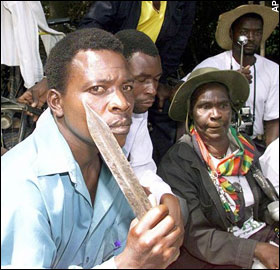
In 2000, the
land issue took on a whole new and more alarming dimension.
In February, gangs armed with axes and pangas invaded white farms across
the country. Government and army
trucks were sued to transport them to the farms, and supply them whilst they
occupied the farms. The government
called them war veterans. They used violence, intimidation and even murder
against the white farmers to force them off their land. Britain planned
evacuation of the farmers, some 20,000 people.
One farmer, David Stevens, was shot dead as invaders occupied and looted
his farm in Murehwa. By June nearly
1500 farms had been invaded. These invasions had desperate impacts on the
economy and peoples lives, with shortages of fuel and rapidly rising food prices
caused by food shortages as farms stopped producing food during the invasions.

Think about it
1. Who is to blame for all of the troubles in Zimbabwe? Fully justify your view.
2. Complete
the time line below on
land reform based upon the text.