



Ageing Populations
 Find out
Think about it!
Population ageing is a shift in the distribution of a country's
population towards older ages. This is usually reflected in an increase
in the population's mean and median ages, a decline in the proportion of
the population composed of children, and a rise in the proportion of the
population that is elderly. Population ageing is widespread across the
world. It is most advanced in the most highly developed countries.
Indeed,
the median age of the UK population is increasing. Over the past 25
years the median age increased from 35 years in 1983 to 39 in 2008. It
is projected to continue to increase over the next 25 years rising to 40
by 2033.
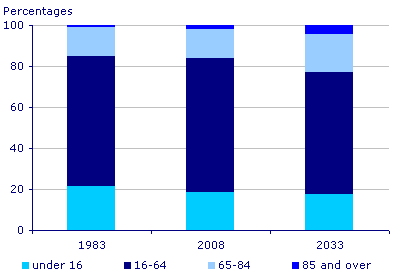
Over the last 25 years;
The percentage of the population aged 65 and over increased from 15 per
cent in 1983 to 16 per cent in 2008, an increase of 1.5 million people
in this age group.
The percentage of the population aged 16 and under decreased from 21 per
cent to 19 per cent. This trend is projected to continue. By 2033, 23
per cent of the population will be aged 65 and over compared to 18 per
cent aged 16 or younger.
This gives a slightly disadvantageous dependency ratio of 0.69.
The fastest population increase has been in the number of those aged 85
and over, the ’oldest old‘. In 1983, there were just over 600,000 people
in the UK aged 85 and over. Since then the numbers have more than
doubled reaching 1.3 million in 2008. By 2033 the number of people aged
85 and over is projected to more than double again to reach 3.2 million,
and to account for 5 per cent of the total population. (Source)
So, Why is the Population Getting Older?
There are a wide range of reasons that we are living longer as a
population. These include:
The
introduction of routine vaccinations
Advances in medical research and technology
Improvements
in
sewage
disposal methods
The ability to control formerly deadly or debilitating diseases
Improvements in diet and fitness
Wider
knowledge about healthy living
A falling
birth rate
Babies born in the soc-called “baby boom” after the Second World War are
now reaching retirement age
This could have severe consequences for many countries including the UK.
Economic Consequences
The UK faces a pension crisis.
At the moment the wages of the working pay the pensions of the
retired. According to the
Independent (view Image below) there is a black hole in the pensions
saving pot. The government
can either raise taxes, encourage more people to save for a private
pension or raise the retirement age.
Already the state pension age (paid for by the taxpayer) has
risen for women to 65 from 60.
In addition, from
2024, the pension age will start rising for men and women, so that by
2046, no one will get a state pension unless they are at least 68. If
this sounds a long way off, think of it this way. If you are under 30
today, your state pension age is 68. If you're in your 30s, you'll
retire at 67, and if you're in your 40s you'll retire at 66 (Source).
The cost of SOCIAL care will rise.
Elderly people often require a lot, more assistance as they age.
Meals on wheels, social care assistants, doctors and nurses all
cost money, but who should pay and how? Indeed, the
cost of social care for the elderly is set to double in the next 15
years just to maintain current standards.
New research by the King's Fund think-tank found that the bill,
projected to reach £8.1 billion in 2015, would hit £12.1 billion in
2026. (source)
Homes and buildings will need to adjusted to cope with the change in
population structure from young to old.
Taxes will have to rise to pay for all of this.
As people age, general health deteriorates. As an example of the
increasing demands for health care from older groups,
Wood and Bain report
that males aged 65–75 years consult their general practitioners 66% more
than those aged 45–54 years, and the cost of prescriptions for males
aged 65–75 are more than double those for males aged 45–64.
NHS staff will need retraining to cope with the increasing number of
elderly people and NHS strategy will have to alter to target the
elderly. Already elderly
people are targeted for the winter flu jab, what else might follow?
Elderly people are more likely to have health problems.
Nearly 700,000 people are estimated to be suffering from dementia in the
UK in 2007 and, by 2025, the number is expected to rise to one million.
You can see some
other statistics here.
This can have a massive societal impact.
It is not all negative however.
Some people are choosing to work longer, passing on their
valuable expertise and experience to the younger generations. In
addition, it is a good thing that people live longer and healthier
lives, and serve a vital role within British family life.
It is also a good reflection of British society, economy and
politics that people live so long today.
