



This is a central development topic and
one that provokes conflict and argument.
There are huge disparities or
inequalities between people WITHIN countries and
between people along the development continuum
from those living in LDCs to those in MEDCs.
Not only are there differences in their
standard of living (an ECONOMIC MEASURE) but these income differences often result in
huge differences in people’s
quality of life
(a Qualitative non-economic measure).
The CENTRAL CORE ISSUE here with this
topic is how we try to reduce these inequalities
so that the poor are not so poor.
Do we promote the values of TRADE, and in
particular, globalised free trade, or do we try
to assist the poorest nations in the world
through AID?
The examiner will expect you to explore
both and include case studies of places to
support your arguments, and then come to a view.
THE BASICS – WHAT IS TRADE?
Trade is the
exchange of goods, money and services between countries and
regions. The goods made in a region and sold to
other places and known as
Exports
(they
Exit
the country or region).
The goods bought into a place from other regions
are known as
Imports
(they come
Into the country or region).
If value of exports for a country or region is
greater than its imports it will have a
trade surplus. If a region imports more than it
sells then it will have a
trade deficit.
Most MEDCs and NICs import primary products
which have low value and export high value
manufactured goods an even higher value
services.
Most LEDCs export lower value primary products (such
as cocoa, cotton etc.), this means that they
struggle to raise standards of living in their
countries because they do not have much foreign
money coming in from trade. The price of primary
goods also varies widely and producers can lose
out massively, so the trade in a sense is
unfair.
Fair Trade
This is a scheme designed to get a
better deal for the
producers
of the primary products that MEDC
countries need. The producers get access to the
market for their goods, a contract (for extra
financial security), better prices for their
products and access to the Fair Trade Premium,
which is a sum of money available from the Fair
Trade foundation to be spent upon improving
yields, farming practices, health care or
education.
Fair Trade is an international movement and its influence is growing,
more than 4,500 products now bear the fair trade
mark, and 72% of the UK population recognise the
Fair Trade logo.
In addition,
more than 7
million people in Africa, Asia and Latin America
benefit from Fair Trade
- farmers, farm workers, and their families.
THE BASICS – WHAT IS AID?
Aid is basically a form of help given from one
country to another; or one person to another, or
from a charity (often called
Non-Government Organisations or NGOs) to a country or region. It is most
likely that you will have given aid at some
point in your life! Aid can be given in the
short term for emergencies, like during the 2004 Boxing
Day Tsunami, when money poured into South East
Asia to help the victims and the sick.
Development aid is
longer term, and seeks to help people in poorer countries raise
their standard of living. Below is a table
summarising the different types of aid;
|
Type of aid |
What it is |
Image |
|
Medical
assistance |
During
emergencies rich nations and charities
like the Red Cross or
Medecin sans
frontiers
can provide medical assistance to the affected
country. This could take the form of
qualified staff or medicines. |
|
|
People |
Richer nations or
charities might choose to send qualified
people top help in poorer nations. In
the short term during emergencies
qualified medical staff and trained
pilots and the army can be of great
assistance. In the longer term teachers,
engineers, consultants can all play a
role in advising and train in people
within a poorer nation, to help its long
term development. |
|
|
Money |
Money is often
sent to LEDCs, for investment in
projects and the local people. The UK
sent £45million in aid to Tanzania to be
spent on education. |
|
|
Large scale
projects |
MEDCs can invest
in large scale development projects,
such as building roads, dams and
factories. The idea behind these
projects is that they act as a growth
point for development, allowing industry
and farming to develop and raise massive
profits. |
|
|
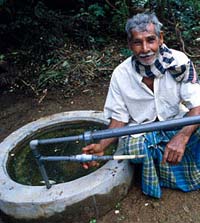
This type of
technology is designed to improve on
current technology within LEDC countries
and to be manageable for local people to
use. There is no point in sending
machinery and technology into an area if
the people can get no use of it because
it is too complicated. |
|
|
|
Equipment |
Large scale
equipment can also be provided in aid to
LEDCs. Equipment such as tractors,
irrigation equipment and earth movers
have all been provided in the past. |



Aid can also be
tied or untied. Tied aid is when the country giving the
aid expects something in return for the aid -
the host country may have to trade more with the
donor country for example. Untied aid is where
the receiving country does not have to give
anything in return.
Debt relief as aid
Many LEDCs took out huge loans (for Millions of
pounds) during the 1970s, offered to them by
banks and governments in rich MEDCs. The LEDCs
wanted to use the money for various development
projects such as building dams, roads, schools
etc. The idea was to help countries to develop
by improving their industries and
infrastructure.
The loans had to be paid back, and the
longer the loan went unpaid the larger it got,
because the MEDCs added a sum of money called
interest every month. Over time these loans got
so large because of interest that some LEDCs
would never be able to pay them off. It also
meant that some MEDCs spent more on loan
payments than on health care and education for
the people living in their countries. This has
had a really damaging effect on the quality of
life of people who live in these areas.
Countries can borrow money from many sources,
including other countries, banks and
international organisations such as the
International Monetary Fund (IMF) and World
Bank.
If a project succeeds debts are easily
repaid and there is no issue.
However, if a project fails debts can
build up because of the interest and countries
can get into huge financial trouble.
This issue can massively affect the
development of a country, which directly affects
the standard of living of the people who live
there.
In the run up the new millennium a campaign was
started to drop the debt, which has had some
success in cancelling some debt, freezing the
interest on some debt and in some cases giving
the poorer LEDCs more time to pay back their
debts. This campaign was called
Jubilee 2000. As a result of this campaign the UK government
cancelled much but not all of the debts owed to
it by poorer nations.
Banks have not cancelled debts however,
and many countries the world over suffer the
effects of debt.
39 developing
countries are
eligible for special assistance from the International
Monetary Fund (IMF)
and the World
Bank.
CONSERVATION SWAPS AS AID
This is another way for poorer countries to make
money and get themselves out of debt.
Many poorer countries have abundant
natural resources and these can be used or
exploited in many ways.
The rain forests are a good example;
these are exploited in an unsustainable manner
for wood, agriculture and mineral wealth.
Conservation swaps offer an alternative
to poorer countries to reckless exploitation of
their natural wealth.
These swaps basically see poorer
countries have portions of their debts wiped out
or paid for by richer nations or charities of
richer nations in exchange for promising to
protect or CONSERVE large parts of their natural
environment.
This has large scale global effects, by
protecting the atmosphere and the hydrosphere.
CASE STUDY - In 1984 the
World Wildlife Fund came up with the idea of
conservation swaps and in 1987 the first was
launched in partnership between the
Government of
Bolivia and Conservation
International (CI) for US$ 650000 which
protected 3 natural areas. Many countries have
since followed, including the Philippines,
Sudan, Zambia, Ecuador and Uganda.
Arguments For and Against Trade and
Aid
|
Aid positives |
Aid negatives |
Trade positives |
Trade Negatives |
|
Aid
is often FOCUSSED on target groups and
problems
– often the poorest people in society and
improving their lives. On the other
hand, trade is less efficient as it is
profit driven and the benefit of trade
is mostly confined within elite group of
people of the country. |
Countries can become dependent upon aid
– this limits their
willingness to follow their own
sustainable development |
International cooperation is promoted in the long
term
Poorer less developed nations want to cooperate with
richer nations for trade advantages.
This will allow a flow of money and
goods into the country.
|
Open free trade can be
very risky to vulnerable economies.
Poorer nations have very fragile
economies dealing with small numbers of
products with high price variability.
|
|
Aid can be given in many
different ways so is flexible.
Emergency
short term aid can be given, and aid
doesn’t even need to be economic, it
could be through the use of advice and
experts.
|
Aid budgets can be cut
– if the donor country has tougher economic times
they might cut the aid budget.
Similarly, if the donor country
does not like current governments or
policies in poorer countries they may
pull the aid money. |
The promotion of trade can have POSITIVE multiplier
effects.
Once an industry or resource or industry is
established and trading globally, other
companies can provide services or
components to that industry boosting the
economy further.
The employment created generates
tax income for the government and people
have wages to spend in the
local economy. |
Trade
requires investment first. Many poor countries do not have the
money to invest in making their
industries efficient so that they can
compete with richer nations and
companies.
|
|
Aid can actually help people,
both in times of
crisis and over the long term.
This fulfils people’s moral
obligations and engenders global good
will. |
Aid can be unsustainable and
inappropriate.
This has particularly
been the case with big aid projects and
tied aid projects.
See the Cahora Bassa scheme on
this website. Aid money has also been
known to “disappear” in corrupt
countries, before it does any benefit
for the people who live there. |
Trade can boost employment.
|
Free trade as desired by the WTO doesn’t
really exist due to protectionism and
trading blocs.
Areas like the EU
protect their industries behind trade
barriers like Import tariffs whilst
subsidizing their own industries.
This damages poorer nation’s
ability to trade. |
|
Aid can stimulate trade,
which may continue into the future after the initial
stimulus.
It can also create jobs for
people from wealthy nations and people
in the recipient country.
|
Aid is difficult to coordinate and
manage
– this is because
there are many sources of aid such as
countries, charities and international
organisation such as the UN.
Each of these donors may have
their own AGENDA. |
TNCs can bring with them technology and
training when they trade in nations.
These are transferrable, so boost the overall
skill and technology level of the poorer
nation. |
Trade can be viewed as a form of
NEOCOLONIALISM.
Many richer nations
and their TNCs are accused of using the
natural resources and people of poorer
nations to their own advantage, a new
form of ECONOMIC colonialism. |
|
Aid can be very sustainable at the local
level and from the bottom up.
Appropriate technology and sustainable
development projects can have huge
impacts on the standard of living of
people at the local scale. |
Aid can be viewed negatively as a
hand out and as a form of charity; where the developing countries need to admit the
superiority of the developed country. |
Trade
helps developing countries to
maintain their dignity, allowing them to
work their way out of poverty
(“give a man a fish and feed him for a day, teach him
how to fish and feed him for life”) |
Trade can encourage a
“race to the Bottom”, as companies seek
the lowest cost producers of goods
normally at the detriment of the natural
environment and the conditions of
employment. |
CASE STUDIES YOU CAN USE;
Trade;
1.
NICs – use China, Malaysia and India as ways that
poorer nations can move towards higher levels of
economic development through trade
2.
Shell – the impact of a TNC on trade, with particular
reference to globalisation.
3.
DR of the Congo – the impact of trade on an LDC
4.
The EU – the way in which a trading Bloc can impact
upon the world trade system
Aid
Cahora Bassa – Aid to an LDC
LARGE SCALE AID – the Cahora
Bassa scheme in Mozambique
Development FACTFILE
|
|
Mozambique |
South Africa |
UK |
|
GDP (PPP) |
$26.22billion |
$578.6 billion |
$2,323 billion |
|
HDI |
0.327 |
0.629 |
0.875 |
|
Birth rate |
39/1000 |
19/1000 |
12/1000 |
|
Infant
mortality |
74.6 |
42 |
4.5 |
|
Life
expectancy |
52.3 |
49.43 |
80.29 |
|
Population
below the poverty line |
52% |
31.3% |
14% |
|
External debt |
$4.88billion |
$47.56 billion |
$9.836
TRILLION |
|
Electricity
production |
14.84 billion
kWh |
257.9 billion
kWh |
352.7 billion
kWh |
|
Electricity
exports |
8.53 billion
kWh |
15.04 billion
kWh |
4.481 billion
kWh |
|
Electricity
from HEP |
99.9% |
1.5% |
1.9% |
Source – CIA Fact book 2013
Dams are often seen by countries as a great way of
raising the development level of a country.
They offer energy for other industries,
the energy they produce is environmentally
“clean” and the construction of such large
structures generates instant employment in
construction and its associated industries.

Mozambique, one of the poorest countries in the world,
attempted to use dam building as a path out of
poverty through the construction of the Cahora
Bassa Dam. This is a good example of bilateral
aid, as although Mozambique now has full
ownership of the dam, initially Portugal had an
82% stake and Mozambique only 18%.
Mozambique also had to contract much of
the work to private companies, diminishing their
share of profits further.
As can be seen in the table, Mozambique
desperately needs a boost to its development,
with low HDI, high infant mortality and low life
expectancy.
The dam blocks the 4th largest artificial
lake in Africa, and is one of 3 major dams along
the mighty Zambezi River which passes through
Congo, Angola, Zimbabwe and finally Mozambique.
It has created a lake that is 292km long,
up to 32km wide and a maximum of 157m deep.

History
The dam was started in the 1960s by the then ruling
Portuguese colonial government, in agreement
with South Africa that a High Voltage Direct
Current (HVDC) Transmission System would be put
into place to move some of the power to South
Africa.
The lake began to fill in 1974 but
unfortunately a long civil war
(post-independence from Portugal) prevented use
of the scheme.
It was the transmission lines and towers
that were damage limiting use of the electricity
that Cahora Bassa could produce.
Finally, in 1995 renewal work began and
by 1997 the dam was back in full operation but
not at full capacity.
Pros
and cons
The dam provides an important power import facility
to the South African grid. It transmits 1920 MW
of power from the Cahora Bassa generating
station on the Zambezi River in northern
Mozambique. One megawatt can power a thousand US
homes on average, so the dam is very good at
producing electricity.
However, only 1% of homes in RURAL Mozambique have a direct electricity
supply, so locals have not benefitted from the
energy produced by the dam. This is because most
of the power is sold to South Africa, which
boosts the national economy but does not benefit
citizens at a local level.
This is unfortunate, as the dam has
enough potential to meet most of Mozambique’s
power needs.
The dam could produce more energy, but its potential is limited by other
dams upstream that keep river flows very low. At
other economic levels, whilst the local shrimp
industry has been destroyed a Kapenta fishery
industry has developed, harvesting 10,000 tonnes
in 2003. The potential for the dam to reduce
flooding has also been a disappointment, with
floods downstream of the dam in 1978.
Mozambique has also had floods on other
rivers in 2000 and in January 2013 (which killed
36 and displaced 70,000 people
- BBC).
These floods are an environmental limit
to development, which the dams such as Cahora
Bassa were hoped to reduce.
AID CASE STUDY 2 –
APPROPRIATE TECHNOLOGY - Kenya
You could use ATA Asia case
study here from Food supply
Intermediate or appropriate technology is a move away
from big aid projects. It aims to use simpler
technologies that are right for the people,
right for the environment and right for the
donor. In most poor countries, high tech
industries are too expensive to develop and
inappropriate to the needs of local people.
Appropriate/intermediate technology is usually;
A)
Labour intensive - utilising and creating employment
for local labour.
B)
Using sustainable technology and tools/knowledge of
local people
C)
Uses newly developed technology that are low cost and
local which local people can manage and control
rather than IMPORTED techniques and technologies
D)
In harmony with the local environment.
Practical Action is a charity who
uses appropriate technology in a number of ways.
It
has over 100 projects
worldwide helping over 900,000 people. One type
of project is using micro hydro-electric power
stations to generate electricity so people can
work their way out of poverty.
Micro-hydro power is the small-scale gathering
of energy from falling water, such as steep
mountain rivers. Using this renewable,
indigenous, non-polluting resource, micro-hydro
plants can generate power for homes, hospitals,
schools and workshops.
In Kenya Practical Action promotes small-scale hydro
schemes that generate up to 500 kilowatts of
power. This provides poor communities in rural
areas with an affordable, easy to maintain and
long-term solution to their energy needs. This
means that this is a great example of
Appropriate Technology. They have also developed
micro-hydro systems with communities in Peru,
Zimbabwe, and Sri Lanka. These systems, which
are designed to operate for a minimum of 20
years, are usually 'run-of-the-river' systems.
Kenya –
The Intermediate Technology
Development Group (ITDG) is a British Charity
which has worked in Rural Kenya. It aims to help
people meet their basic needs of food, clothing,
housing, energy and employment. It uses local
knowledge, training and finance to help people
become more self-sufficient. In Kenya the ITDG
has used soil as a local building source - as it
can be compressed and it absorbs heat well. It
can be stabilised against erosion using lime and
natural fibres. Soil bricks stabilised with
concrete are replacing more expensive
industrially produced bricks.
The
previously
Nomadic Maasai herdsmen are being
forced to become sedentary. ITDG is helping them
find affordable housing, helping them repair
roofs with small amounts of cement, and by
incorporating guttering and water collection
jars into housing women are being spared the job
of walking long distance to collect water.
Kenyan
women rely on wood for cooking. This can take
rural women a long time to collect. An
improved cooking
stove (jiko)
has been developed that reduces the amount of wood and charcoal needed and
is based on a traditional design and constructed
using scrap materials.