



Globalisation
refers to the process by which the world’s local
and regional economies, societies, and cultures
have become integrated together through a global
network of communication, transportation and
trade.
With reference to industry it is also the shift
to a globalised economic system dominated by
supranational (across and above the governments
of nations) corporate trade and banking
institutions.
There are three main forms of globalisation:
1.
Economic globalisation–
the growth and spread of Trans National
Corporations, the rise of NICs, the rise of
global economic institutions like the IMF and
World Bank
2.
Cultural globalisation–
Initially this was the impact of western
culture, art, media, sport, and leisure pursuits
on the rest of the world.
This is now a multidirectional process,
as cultural aspects move all over the globe
through the Internet and migration.
Hollywood is now rivalled by Bollywood
and Nollywood for example!
3.
Political globalisation–
Institutions like the United Nations, regional
trading blocs and particularly the influence of
western democracies and their influence on poor
countries have resulted in political
globalisation.
The History of Globalisation
Globalisation is thought of as a recent
phenomenon that is driven by inventions like the
airplane or the Internet. However, globalisation
has been taken place for centuries; it is just
that the
pace of this process
is accelerating.
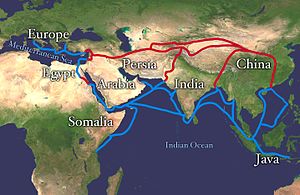
The Silk Road is a great example of early
globalisation, which spanned from Europe all the
way to East Asia, moving silk and other products
from as early as the 2nd century BC.
The invention of steamships and railroads
expanded the process of globalisation, and
humans have engaged in cultural exchange and
international trade for centuries.
Some of the forerunners in Globalisation were
the British and Dutch, when the Dutch East India
Company and the
British East India Company
started trading with India and then China. These
trade relations have slowly been translated into
Globalisation or Free Trade. It could also be
argued that the slave trade or triangular trade
was another driver of globalisation.
There are different theories and ideas about
globalisation, and it has its supporters and
critics.
Some suggest that globalisation leads to
efficient use of resources and benefits all who
are involved. Others dislike globalisation and
claim it is increasing inequality between the
very rich and the very poor.
Some major patterns of Globalisation and trade
are that;
-
MEDCs
or richer countries tend to produce
MANUFACTURED secondary goods such as
cars or computers and sell lots of services.
These are high value goods.
-
MEDCs also produce a lot of research and
development products and SERVICES
such as legal and banking services – again
high value
-
LDCs
or the poorest countries tend to produce
lower value raw materials or farm goods such
as Bauxite or cotton.
These are PRIMARY PRODUCTS
-
MEDCs import a lot of raw materials at low
prices, but sell higher value processed
goods.
The MEDCs “Win” in this process.
-
MEDCs
make rules that limit poorer countries
ability to compete – by paying their farmers
SUBSIDIES to make their goods cheaper
OR taxing Imports (an import tariff). This
makes trade UNFAIR
-
LEDCs
often have a lot of DEBT so it is
hard for them to start up secondary
industries
-
The control of the trade rests with
the richer countries (MEDCs) who have
the major markets and buying POWER;
prices controlled on world markets so are
out of poorer country control
-
NICs are changing this pattern, rivalling
the richer “Western” nations – manufacturing
is in decline in many MEDCs
-
Trading Blocs
have led to
trade creation between members;
countries outside the bloc have suffered
from
trade diversion.
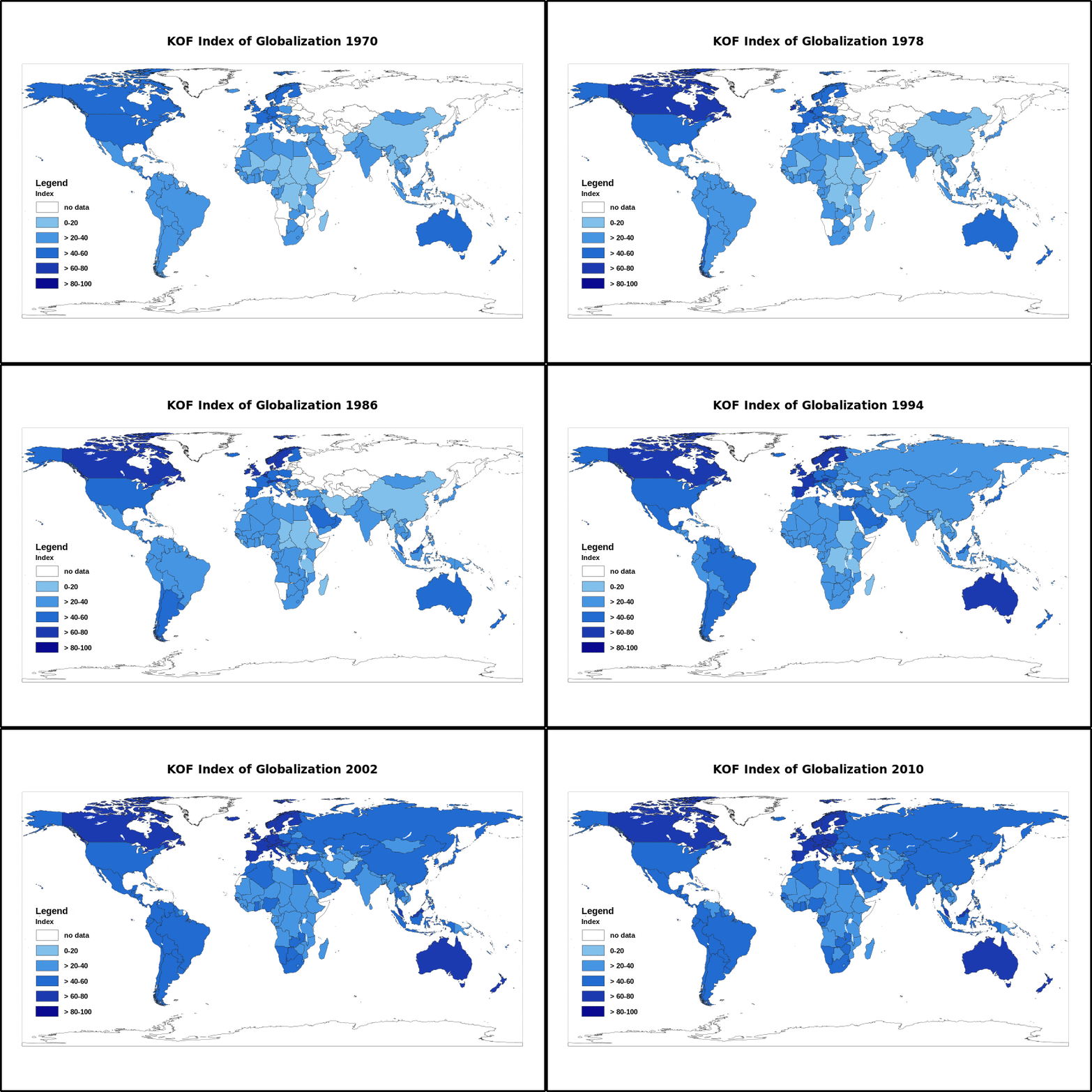
How is Globalisation measured?
The
KOF index
measures social, economic and political measures
of globalisation, on a scale of 0 to 100 with
100 being most globalised. A map of this
COMPOSITE INDEX is shown below.
A popular way to consider globalisation patterns
now is using Internet traffic data, as shown
below.

The IMPACTS of globalisation
“We
believe that the central challenge we face today
is to ensure that globalisation becomes a
positive force for all of the world's people.”
(UN Millennium Declaration, 2000).
Below are MANY of the pros and cons of
globalisation, you do not need all of these, but
you should know some backed up with evidence.
|
|
Benefits |
Problems |
|
ECONOMIC |
Globalisation is tied up with Free
trade, and this reduces the barriers
that once stood between nations trading
freely with one another. This means
companies can profit. Examples of free
trade agreements are the North American
Free Trade Agreement (NAFTA), which
allows Mexico, Canada, and the United
States to exchange products and services
without significant import and export
restrictions.
Under both GATT and WTO, world trade has
expanded rapidly |
Globalisation can lead to the ‘labour
drain.’ Since globalisation allows
workers to easily move from one country
to another. This can also lead to a
“brain drain”, where after receiving
training in their home countries; many
SKILLED people emigrate and spend their
professional career in a WEALTHY economy
at the expense of their home country.
This
costs the African continent over $4.1
billion in the employment of 150,000
expatriate professionals annually |
|
Globalisation creates a steady cash flow
into the poorer and indebted countries,
which gradually decreases inequalities |
Some economists believe that free trade
is only possible if industries in poorer
countries are allowed to grow under a
certain level of economic protection.
This is known as the Paradox of Free
Trade. |
|
|
Companies can also hire workers in
foreign countries to work for them using
online tools and telecommunications.
This reduces company’s costs.
TNCs have profited from this.
|
Some countries can lose out on tax
revenue. Since many companies are able
to trade with one country while being
based in another, large corporations
often exploit tax havens such as
Luxembourg, Switzerland, and Hong Kong
to avoid paying taxes in the countries
where they generate their profits. |
|
|
There is a worldwide market for the
companies and for the customers there is
a better access to products from
different countries |
Globalisation has had a cultural impact
on many countries that have been subject
to large-scale immigration. Many critics
of globalisation feel that the free
movement of labour has resulted in the
weakening of specific cultures. |
|
|
In many cases, free movement of labour
allows economies to fix ‘gaps’ that
exist in their labour markets. For
example, the United Kingdom has hired
nurses from India to fill positions in
its public hospitals that were
previously empty due to local labour
shortages. |
Specialisation of countries in one or 2
single products makes them particularly
vulnerable to changes in the market
price.
If the price falls the country
loses its source of income. |
|
|
Free trade also allows nations and
economies to specialise, producing
higher quality goods at better prices.
If a country, for example, has large oil
reserves but little land that’s suitable
for farming, it can focus on oil
production while importing fresh food
from abroad. |
Globalisation can swamp weak economies
with products, ruining local markets.
In Kampala in Uganda the dumping
of cheap clothes donated to charity
decimated the textile industry. |
|
|
CULTURE |
Culturally we have become more open and
tolerant towards each other, cultural
intermingling is common and those who
live in the other parts of the world
appear more approachable than before. |
Languages differences are being eroded
by dominant the dominant language of
business, English.
This is putting some languages
under threat of extinction. |
|
There is a lot of technological
development that countries have
undergone over the years. Thus, helping
in sharing of information and
technology. This helps most of the
poorer nation’s progress at the same
speed as the rich industrialised
nations. |
Globalisation may lead to loss of
cultural identity as Western ideas are
sometimes imposed upon other nations. |
|
|
SOCIAL |
In a globalised world, workers can more
easily move from one country to another
to market their skills to employers and
contribute to the economy.
|
There are some experts who think that
globalisation is also leading to
communicable diseases spreading (e.g.
Ebola) and social degeneration. |
|
Consumers enjoy a greater choice of
goods and services from Free Trade,
since foreign companies can easily offer
their products for sale. They also
benefit from lower overall prices for
goods, as a greater variety of goods for
sale increases competition and drives
prices down. |
Corporations could end up “ruling the
world” ahead of governments because
there is a lot of power and money
invested by them due to globalisation.
This poses problems as people in
poorer countries are often exploited in
“sweatshops”. |
|
|
|
There is immense pressure on the
employed people of rich industrialised
countries who are always under the
threat of their jobs being outsourced to
poorer nations. |
|
|
POLITICS |
Globalisation forces politics to merge
and decisions that are being taken can
be beneficial to people all over the
world. |
Many nation states feel that they are
losing control over key decisions and
sacrificing their sovereignty.
It is this reason that is given
for the UK not joining the Euro single
currency. |
|
Global networks give oppressed people a
voice, social media was used in the Arab
Spring protests for example |
The major agents of globalisation, such
as the IMF and World Bank, are based in
Wealthier nations. |
|
|
ENVIRONMENT |
Since we share financial interests,
corporations and governments are trying
to sort out environmental problems for
each other.
The Montreal Protocol of 1987 on
Ozone depletion is a great example of
this. |
Many economists and environmentalists
have criticised globalisation due to its
environmental impact. This can be seen
in the increasing numbers of air miles
for our food and declining air quality
in places like China where many
manufactured goods are produced. |
Consider the diagram below and print it Click on the image for a clearer view.
What are the local, national and global economies?
What different sections comprise the global economy?
How are all of these areas linked together? add these links and explain them on the diagram

Complete the graphing exercise found here