




India has a large manufacturing sector and a large agricultural economy
(that has been transformed by the Green
Revolution).
However, it is India’s
software and ICT services that have been in the
forefront of economic growth. India has taken
advantage of the fact that many of these
industries are FOOTLOOSE – i.e. they are not
tied to a particular location but can actually
locate anywhere globally as long as the labour
force is up to the job. Indeed,
what they require is an educated workforce with IT skills,
Offices or business parks, access to
communications systems, and favourable
government policy. These are available GLOBALLY.
These
contrasts to the
location of many manufacturing industries are
controlled by access to raw materials as these
can be heavy
·
Service sector
-
The portion of the economy that
produces intangible (can’t really be touched)
goods. The end products are services, not
finished products like a car, but perhaps the
Satellite Navigation system software within the
car.
·
Offshore outsourcing
- a type of business process outsourcing
(BPO), it is the exporting of IT-related work
from the United Kingdom
and other
developed countries to areas of the world where
there is both political stability and lower
labour costs or tax savings.
·
Back office functions
-
generally considered to be all of the things
unseen to the CONSUMER including the technology,
services and human resources required to manage
a company itself.
·
Information Technology Enabled Service (ITES)
– a form of outsourcing covering financing, administration,
telecommunications and human resources using
information Technology
The major
locations for India’s service sectors and IT
industries are shown on the maps below.
Note that the growth in these industries
is not even throughout India.

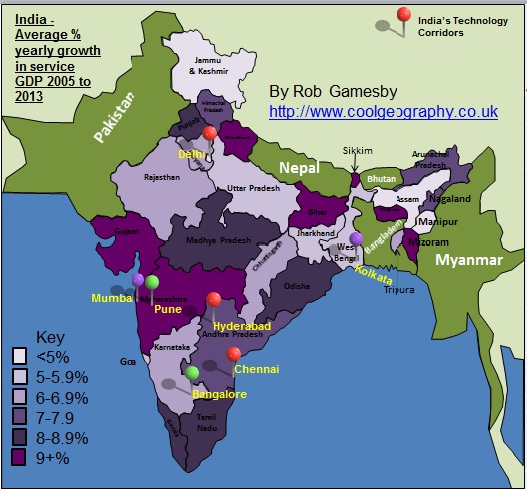
Facts about India’s service sector;
1.
India stands out
because India’s service sector currently is
close to 60% of the economy (source). This has increased from 15% in 1950
2.
Companies attracted to India and its Special Enterprise zones
include Nokia SEZ in Tamil Nadu (telecom
equipment/R&D services), Motorola and DELL, and
Infosys Technologies in Bangalore.
3.
The demand for Indian BPO services has been growing
at an annual growth rate of 50%
4.
Indian IT and BPO generates $71 Billion per year
5.
Approximately 4million Indian’s worked directly in
BPO and IT in 2015
6.
Indian BPOs handle 56% of the world's business
process outsourcing
7.
India’s BPO contributes about 5% to annual GDP
8.
In 2009, the top 15 technology outsourcing companies in the
world included seven Indian firms, including
Tata Consultancy Services, Wipro Technologies
and
Infosys
Technologies.
Source
9.
Indian companies are also expanding across the world e.g.
Tata Consultancy services has delivery centres
in Argentina, Brazil, China, Hungary, Mexico,
Singapore, USA and Uruguay, plus numerous
centres in India.
Why has India developed
as a major GLOBAL service provider?
1.
It has the second largest English speaking workforce in the
world -
a legacy of colonisation
2.
Cost are low (particularly labour costs) and products are
generally high quality – cost savings were
initially 30-40% for companies (source)
3.
The Government is supportive to companies willing to invest
their foreign capital and expertise and offers
supportive policies.
This has happened since 1991 and this
included the government liberalising its economy, getting rid of
barriers to trade such as tariffs, allowing 100%
foreign ownership of firms and allowing foreign
direct investment.
This includes
the idea of
Software Technology Parks of India
(STPI) whose objective was to encourage, promote
and boost software exports from India. In 2000
the Indian Government announced a policy to
create Special Economic Zones, and by 2009 578
had been set up.
These create $15billion in exports and
employ more than 1/2million people.
4.
People and companies are able to adapt to new technologies
5.
The government is stable and India is the world’s largest
democracy, since independence in 1947 (Indian
Independence Act)
6.
India offers Legal protection for intellectual property rights
7.
India has good infrastructure in terms of energy, data
communication and transport.
8.
India has the World’s second largest population after China
and also a large middle class population of
267million people expected to expand to
547million by 2025.
These people have extra purchasing power
so the Indian Market is very large and
attractive
9.
The population is EDUCATED – there are well over 1.5 million
IT professionals for example.
India also creates over a million
graduates each year, which includes 350,000
engineers.
10.
India is part of the
South Asian Association for
Regional Cooperation (SAARC) so businesses operating in India can access those
markets too
11.
There are Technology corridors throughout India
which provide a focus on technology, innovation
and knowledge based industries.
These also boast well developed R&D
functions.
12.
Location – India is in a position to provide
services during the night to be ready for US and
European markets in the morning because of the
time difference.
(Source of much of this – Geofile 617 “the globalisation of services – calling India”)
Tasks
Read pages 187 to 190 of AQA Geography. Produce a promotional leaflet on why many high tech industries have relocated to Bangalore in India, and why other firms should do so.
You should cover a range of Geographic points in your report, to include social, economic and environmental reasons to locate in Bangalore.
The following resources might help you;
Advantages of India as a country
A.T.Kearney, leading financial firm - report on country attractiveness for investment
Infosys.com -the official Infosys website - a major employer in Bangalore
For information about the High tech park click here
Review - what do you think of the concept of a FLAT WORLD as proposed by Infosys? Think of the advantages and disadvantages of this concept