



A newly industrialised country is a country in
which development has been rapid over its recent
history.
It is a socio-economic term in that
countries are classified by economic factors
such as GDP, and rapid GDP growth rates, but
also improving social factors such as life
expectancy and education levels.
In many
cases, NICs are countries where the economy IS
NOT AS HIGH AS developed country status but have
grown much FASTER than other LEDC and LDCs.
Common features of NICs;
1.
Rapid economic growth normally based on
exporting goods (e.g. China) or possibly
services (e.g. India). Growth in the economy was
in excess of 7% every year
2.
Industrialisation that is rapid within the
country
3.
Rapid urbanisation via rural to urban
migration as people flock to growing
manufacturing industries
4.
Stable governments and strong political
leaders that allow the country to develop
5.
Large amounts of FDI (Foreign Direct
Investment, also known as INWARD INVESTMENT)
from overseas TNCs and other countries
6.
A move from a primary (often agricultural)
economy to an industrial economy
7.
The development of the NICs own Transnational
corporations
8.
Have a large influence in their continental
region (e.g. China in Asia)
9.
An increasingly open market economy.
This may be were the country initially
protects its own industries behind tariff
barriers allowing them to develop, but then
opens up its markets to trade more freely with
other places allowing more FDI
Initial growth
·
The original Asian Tiger
economies are
Hong Kong, Singapore, South Korea
and Taiwan.
They experienced rapid growth between the
1960’s and 1990’s.
·
The next batch of NICs were the Tiger Cub
Economies of
Indonesia, Malaysia, the
Philippines, and Thailand, the four
dominant countries in
Southeast Asia.
Their growth started c.1980
·
Celtic Tiger referred to the
Republic of Ireland’s
rapid growth from 1995 to 2008, whilst
Baltic Tigers of Estonia, Latvia, and Lithuania
grew rapidly from 2000 until 2006–2007
·
Brazil, Russia, India and China
were
recognised for the rapid growth in 2001 as
BRIC countries
and South Africa was added to make it
BRICS
·
Mexico, Indonesia, Nigeria and Turkey (MINT)
were coined
the next batch of growth economies in 2014
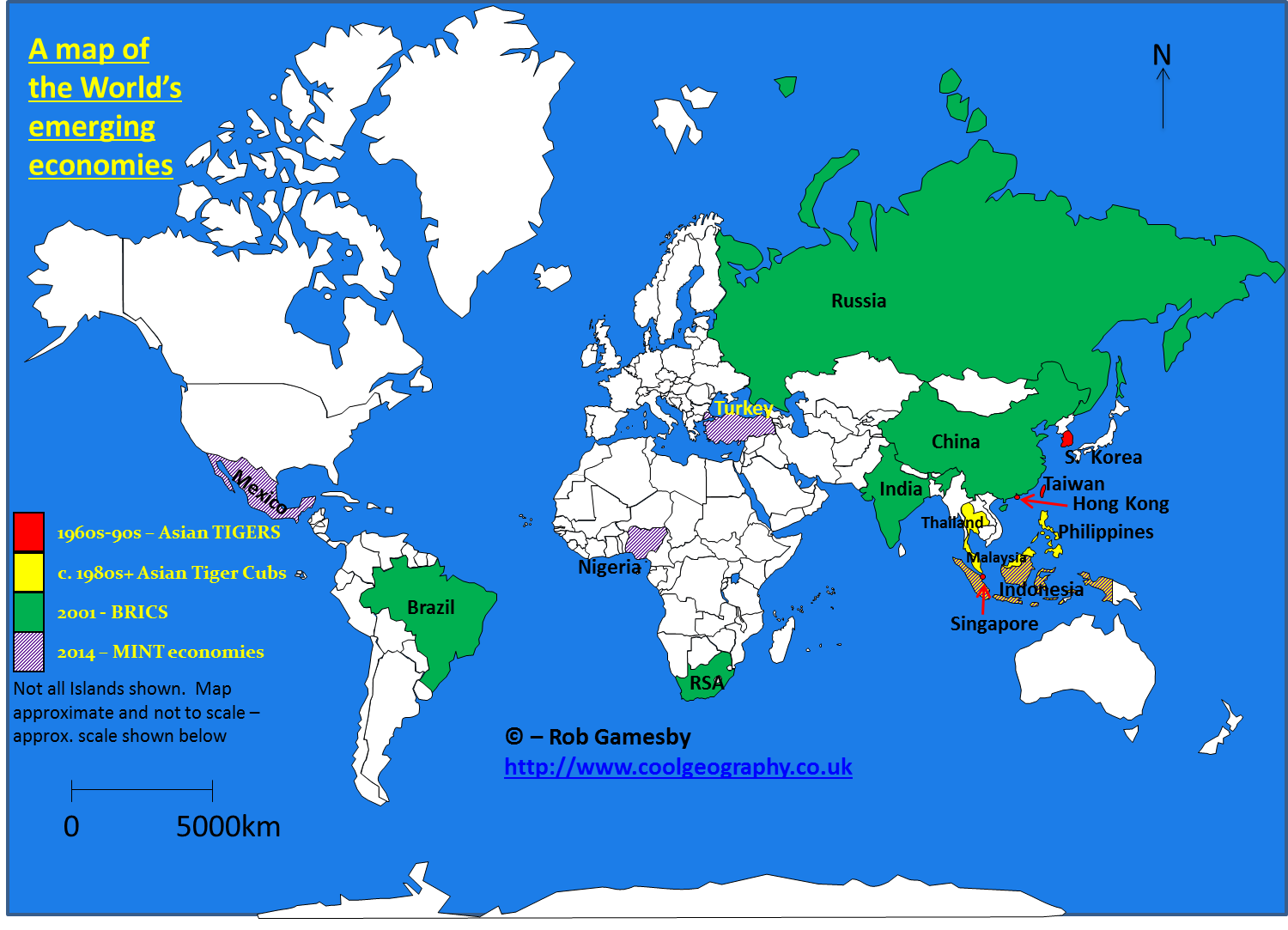
GROWTH FACTORS FOR NICs
Many of these countries based the growth around the following factors or
ADVANTAGES;
·
low labour costs,
·
expanding domestic (home internal) markets,
·
available raw materials,
·
reduced import and export tariffs,
·
weaker legislation with regards to staff safety and welfare, protecting
the environment and planning.
All of these
factors gave manufacturing industries an
advantage in terms of COST so many richer
countries TNCs set up branch plants in NICs or
relocated their manufacturing there TOTALLY.
Indeed, many of the industries involved low
skilled activities with low technology but high
labour input.
Not all of the initial advantages to
companies are advantageous to society however,
and are detrimental to people’s health and
welfare.
These NICs began to dominate
manufacturing in electrical goods, textiles and
clothing, shipbuilding, and increasingly have
moved into car assembly.

Image © Rob Gamesby
http://www.coolgeography.co.uk
RECENT COMPETITION TO NICs
More recently, NICs
have developed their own TNCs, India has the
TATA Company and South Korea has Samsung and
Daewoo. As the original NICs have been
challenged by cheaper rivals, they have been
forced to invest in those cheaper countries to
remain profitable! This saves on labour costs,
they have also had to invest in protected
markets such as the EU by setting up branch
plants there, Daewoo has an assembly plant in
Romania for example that allows it access inside
the protectionist EU.
Other avenues the original NICs have
explored are opening up new or virgin markets
such as in parts of South America and Africa.
The Asian “Tiger
Economies”
The Asian Tigers were also
known as the Asian Dragons. These
Asian Tigers developed highly advanced and free
economies from 1960 onwards and includes Hong
Kong, Singapore, South Korea and Taiwan.
All 4 countries managed to maintain HUGE
economic growth rates of over 7% every year and
had very rapid industrialisation.
Today, all 4 have developed into advanced and high-income economies,
specializing in areas of competitive advantage.
·
Hong Kong and Singapore have become
world-leading international financial centers,
·
South Korea and Taiwan are world leaders in
manufacturing information technology.
Their economic success stories have been copied or used as examples by other
developing economies. Their data plus that of
Malaysia (from 2014) is shown below.
More information is available here.
|
|
|
Population |
GDP PPP
Per capita ($) |
Trade
(Millions of US $) |
HDI
(rank in brackets) |
Median
per capita income (US $) |
Corruption perception Index (100 –
very clean) |
GDP
growth rate
(%) |
|
MEDC |
UK |
63,742,000 |
37,300 |
1,595,700 |
0.892
(28) |
26,904 |
76 |
1.7 |
|
Tiger Cub |
Malaysia |
30,073,000 |
23,160 |
423,900 |
0.773
(62) |
10,060 |
50 |
5.6 |
|
Original Asian Tigers |
Hong Kong |
7,219,700 |
52,984 |
944,800 |
0.891 (15th) |
9,705 |
77 |
2.9 |
|
Singapore |
5,399,200 |
78,762 |
818,800 |
0.901 (9th) |
7,345 |
87 |
3.9 |
|
|
South Korea |
50,423,955 |
33,791 |
1,084,000 |
0.891 (15th) |
11,350 |
56 |
3.0 |
|
|
Taiwan |
23,386,883 |
41,539 |
623,700 |
0.882 ( 22nd) |
6,882 |
61 |
3.3 |
Malaysia – a case study of an Asian
Tiger Cub
Malaysia is tropical country that occupies a
peninsula south of Thailand and part of the
Island of Borneo (which it shares with Indonesia
and Brunei).
It is a tropical country which would have
originally been CLASSIFIED on the on the
southern side of the North-South divide, which
places it within the less economically developed
world. This is now inaccurate, due to Malaysia’s
impressive economic growth as one of Asia’s NICs
(newly industrialising countries) over the past
40 or so years.
Malaysia is an Asian Tiger cub, one of the
second waves of Asian tiger economies. Prior to
1970 it was a classic agricultural nation that
specialised in exporting raw materials - rubber
and tin made up two-thirds of the value of
exports in 1970.
By the end of the 1990s over 80% of exports were
manufactured goods.
How did Malaysia grow economically?
1.
Labour –
Malaysia had cheap labour in
abundance in the 1970s and fulfilled consumer
demand in richer MEDCs
2.
Transport –
Malaysia had major ports such as
Georgetown on Penang, this helped with trade
3.
Education –
Malaysia has and had a well-educated
workforce
4.
Government and politics –
the country was
governed by strong leaders including
Dr Mahathir Mohamad who ruled from 1981 to 2003
who oversaw economic growth and increased
prosperity for the people of Malaysia.
5.
Industrial policy
– Malaysia allowed foreign companies to come in
and invest, then strongly promoting the
development of locally owned industries through
protection and laws to give these home-grown
industries privileges compared with foreign
investors.
6.
Growth poles - manufacturing was
concentrated in growth poles in Malaysia. Domestic goods such
as food and drink and household goods are
located in and around the capital city, Kuala
Lumpur, which has an inland location. The
export-orientated growth industries, mainly
electronics but also including electrical goods,
machinery, equipment and textile industries, are
concentrated south of Georgetown along the
eastern side of the island of Penang, close to
the port and the road bridge connecting Penang
to the mainland and international airport.
7.
Development of TNCs – Malaysia has its own car manufacturer,
Proton, which sells cars to every continent

Try this exercise on NICs using Excel