



Aspects of globalisation - a case study of a TNC
Shell
Shell is one of the richest companies on Earth, does business in
many countries and deals with 25million customers every day.
It has refineries, drilling fields, 65,000 filling
stations and employs many people worldwide.
Its headquarters are in The Hague in the Netherlands but
the parent company,
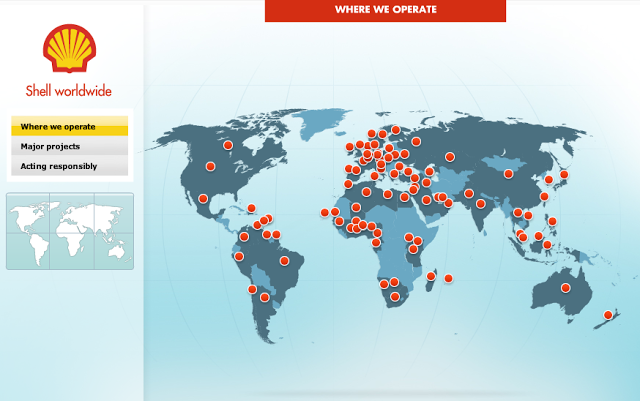
Royal Dutch Shell plc, is incorporated in the UK. The map below
shows where they operate;
Shell by numbers (figures for 2013)
|
Facts |
Financial performance 2013 |
Sustainable development 2013 |
|
·
Shell operate in +70 countries
·
92,000 average number of employees
·
19.6 million tonnes of equity LNG sold during the year
·
3.2 million barrels of oil equivalent
produced every day
·
30+ refineries and chemical plants run
|
|
|

The
business is split into 3 major areas;
1.
Upstream
- explores for and extracts crude oil and natural
gas.
2.
Downstream - Refines supplies, trades and ships crude worldwide, manufactures and
markets a range of products, and produces
petrochemicals for industrial customers.
3.
Projects
& Technology - manages delivery of Shell’s
major projects and drives the research and
innovation to create technology solutions.
The
History of Shell
Shell started as an imported of goods into
London in the late 19th century and
was a family firm that shipped seashells as
ornaments from where it derives its name.
In 1890 it started shipping oil from
Russia to Japan.
In 1907 it merged with Royal Dutch to
become Royal Dutch Shell group and helped to
fuel the boom in the automobile industry.
Shell US was a big money spinner and sold
petrol in 48 states.
It is a truly multinational company,
drilling, producing and refining then selling
oil all over the world.
It then started to branch into other areas such
as the production of petrochemicals, for many
plastics and other products.
It is also heavily involved in natural
gas.
Positive and negative impacts of Shell as a TNC
|
Positives |
Negatives |
|
THE ENVIRONMENT
Shell stated that they make every effort to clean up the environment
after oil spills - “We must improve our
environmental performance and make up
for past mistakes, including cleaning up
oil spills, preventing new ones and
ending the continuous flaring of gas.
In 2004 we cleaned up 199 sites,
exceeding our target of 100.
We are on course to restore all
spill sites that have been identified
for remediation by the end of 2006.”
It launched the
Shell Foundation
in 2000 with $30million to fund
sustainability and
biodiversity and help local communities.
Its core business remains oil.
ENCOURAGING
DEVELOPMENT
$12 billion spent in lower
income countries.
RENEWABLE ENERGY
Shell covers geothermal, solar and wind energy as part of its renewable
energy program.
Renewable energy and reducing carbon emissions are targets of the
company.
Shell also claims to embrace
corporate social responsibility.
The company tries to consider all
stakeholders, not just shareholders.
Since the early 90s Shell has made positive practical moves including
pulling out of projects in Cameroon and
Pakistan on Human rights issues, but
remains in Nigeria.
Shell paid £20billion in corporation tax in 2013; this can be used by
the governments of the countries it
operates in.
Shell employs on average 92,000 people globally.
|
Oil spills and the environment
Drilling for oil is dangerous and dirty, and the products are toxic –
This is part of Shell’s accident record;
1947 US tanker ship blows up killing 10
1968 – Netherlands refinery fire, 2 dead, $120million damage
1970 – Gulf of Mexico oil well blowout, 4 killed, $25million damage
1980 – Hawaii terminal fire, 2 dead and $3million damage
1988 – San Francisco Bay 400,000 gallon spill, birds killed, wetlands
damaged
1989 – 150 tons of crude oil leak into River Mersey – widespread
environmental damage
CHEMICALS
From the 1940s Shell marketed pesticides called DDT, Endrin etc. that
killed humans as well as agricultural
pests.
Shell was very slow to pull these
products of the market, and poisoned
soil and wildlife.
They only stopped marketing the
product when Washington outlawed them
but they continued to sell them in the
third world. Diamond in Louisiana also
had its watercourses polluted by Shell
pollution until the 1960s, people were
also exposed to 100 to 1000 the normal
levels of chemicals in the air.
BRENT SPAR
Shell drills for much of its oil offshore and environmentalists have
long worried about the impact on the
sea.
The Brent Spar was a massive oil
tank in the Atlantic Ocean which Shell
decided to dispose of by dumping it into
the sea.
Before they could do this
Greenpeace occupied the rig claiming
they were trying to save the sea from
death by pollution.
Shell evicted them by force and
the issue became a worldwide
controversy.
Shell stated – “Brent Spar was
damaging to our reputation: despite the
support of independent scientists for
our proposals we did not win public
acceptance.
We recognised the need to change
our approach; our experience with Brent
Spar has taught us that sticking to the
letter of the law is not enough.
We need to dispose of
installations in such a way that is also
acceptable to broader society”
HUMAN RIGHTS VS. OIL
The Niger Delta contains Ogoniland, home to a community that fought
back against Shell.
Shell has extracted $30billion
worth of crude oil from the land of the
Ogoni people since the 1950s.
Oil revenue makes up 80% of the
Nigerian economy and ½ of that comes
from Shell.
This has had consequences for the
Ogoni people, many of whom live without
electricity or running water, who see
none of the oil profits and have to live
with the poisoning of land and water
from pipelines, oil spills and gas
fires.
Ken Saro-Wiwa, organised the locals into the Movement for the Survival
of the Ogoni People (MOSOP) who used
non-violent protest methods against the
power of Shell.
The protest movement were
attacked, killed and mutilated and some
people blamed the government for this.
The military Government made
their intentions clear and Ken Saro-Wiwa
said on May 10 1994 – “This is it.
They (the Nigerian army) are
going to arrest us all and execute us.
All for Shell”.
On May 22nd 1994 Ken
Saro-Wiwa was arrested on a murder
charge, he told the tribunal “I and my
colleagues are not the only ones on
trial.
Shell is here on trial….The
company has indeed ducked this
particular trial but its day will surely
come”.
Despite massive pressure from
Germany, France and Australia, Saro-Wiwa
was hanged with 8 other protestors in
1995.
John Major (the then UK prime
minister) declared it as indefensible.
|

A Shell refinery in Northern Canada