



Reasons for, and consequences of the social and economic groupings of nations
CAUSES and REASONS
Many countries group
together for different reasons;
1.
TRADE - There are several trading
blocs, such as the NAFTA (North American Free
Trade Association),
2.
GLOBAL GOVERNANCE (economic)–
such as other ECONOMIC groupings include the
World Bank (An international
organisation dedicated to providing financing,
advice and research to developing nations to aid
their economic development),
IMF (International Monetary Fund who…) and the
World Trade Organisation (WTO) who
3. GLOBAL GOVERNANCE (SOCIAL) - There are global organisations of countries too, including the United Nations who have a huge role to play in organising the countries of the world to combat environmental issues such as Global Warming, tackle poverty through the UNDP, and ensure safety of people in conflicts through the use of the UN’s peace keeping force
4.
DEFENCE – There are defence
groupings such as NATO (North Atlantic Treaty
Organisation)
5.
SOCIAL, POLITICAL and ECONOMIC
unions – the European Union is a great example
of this, where various aspects of politics, law,
society and the economy of member states are
governed by the group of nations.
CHARACTERISTICS
A trading
bloc is defined by four characteristics:
1.
There is a special trade relationship that promotes
and allows trade within that group of countries
in preference to trade with outside nations by
discriminating against non-members (through
import tariffs for example)
2.
It has the goal of trade
liberalisation or integration with the
aim of establishing a free trade area, customs
union, or common market
3.
It strives to reach common positions in
negotiations with third countries, with other
trade blocs, or in multilateral forums
4.
It attempts to coordinate
national economic policies to minimize
disruption to intra-bloc economic
transaction
(source)
Key words
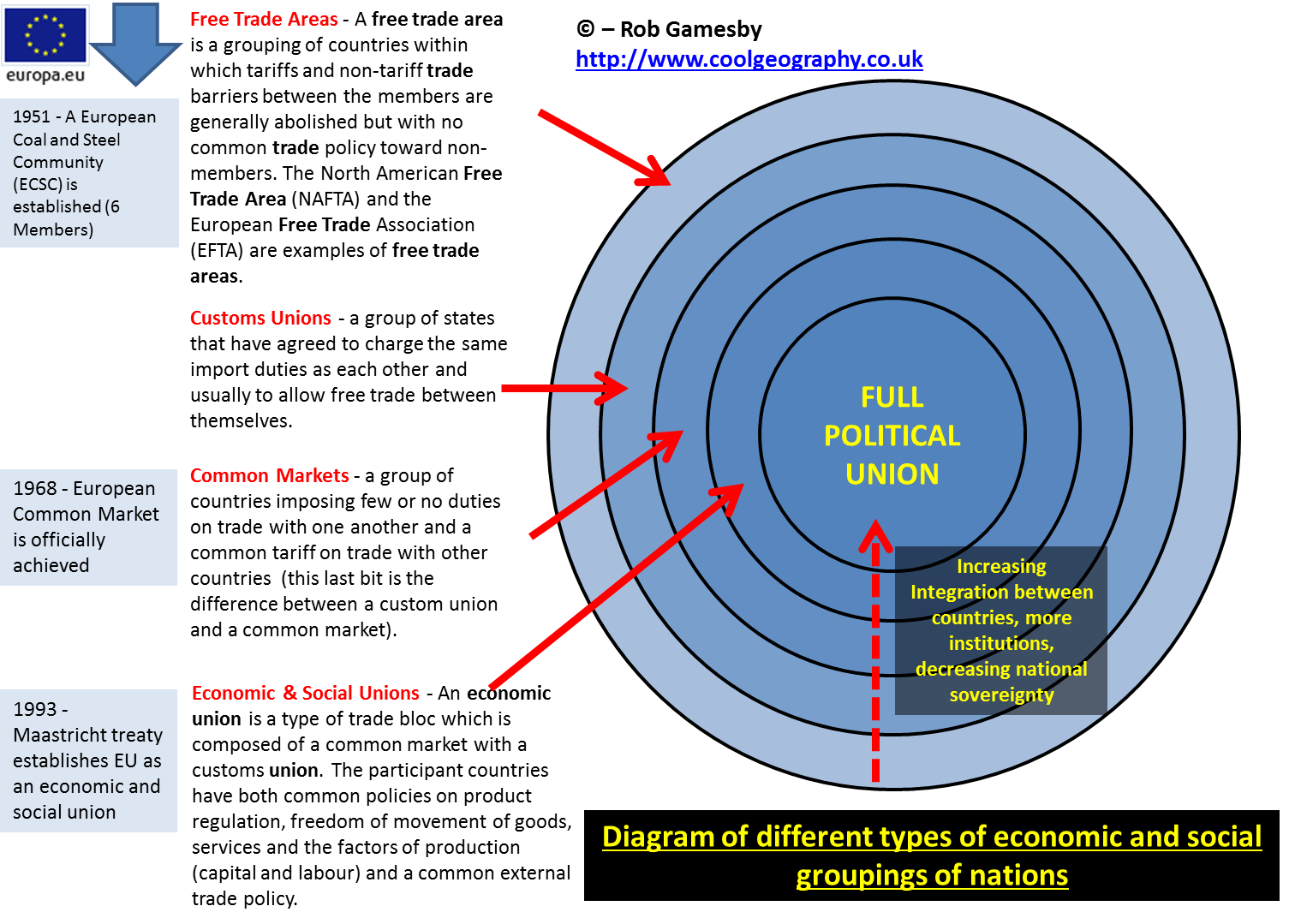
Free Trade Areas -
A free trade area is a grouping of
countries within which tariffs and non-tariff
trade barriers between the members are
generally abolished but with no common trade
policy toward non-members. The North American
Free Trade Area (NAFTA) and the European
Free Trade Association (EFTA) are examples
of free trade areas.
Customs Unions -
a group of
states that have agreed to charge the same
import duties as each other and usually to allow
free trade between themselves.
Common Markets -
a group of countries
imposing few or no duties on trade with one
another and a common tariff on trade with other
countries (this last bit is the difference
between a custom union and a common market).
Economic Unions -
An
economic union is a type of trade bloc which
is composed of a common market with a customs
union. The participant countries have both
common policies on product regulation, freedom
of movement of goods, services and the factors
of production (capital and labour) and a common
external trade policy.
NAFTA
– the
North American Free Trade Agreement – came into
place in 1994 to ensure free trade between the
USA, Canada and Mexico. Over the first 20 years
of its existed it resulted in a 400% increase in
trade between member states, included developed
and developing countries and created a market of
460million consumers. (Source)
EU – the
European Union
EEC –
European Economic Community created by the
Treaty of Rome in 1957, renamed as the European
Community in 1993
GATT – the
General Agreement on Tariffs and Trade, which
was signed in 1948 with the aim of reducing
tariffs or import duties between countries and
to have a forum for discussing the problems of
international trade.
It was replaced in 1995 by the WTO or
World Trade Organisation
WTO – the
World Trade Organisation
BRIC –
Brazil, Russia, India and China – a group of 4
countries identified by Jim O’Neil from Goldman
Sacs as upcoming major global economic powers in
2001.
MINT –
Mexico, Indonesia, Nigeria and Turkey - the next
batch of potential economic giants identified
again by Jim O’Neil in 2014.
G8 – The
“Group of 8” most powerful countries in the
world, which includes
France,
United States, United Kingdom, Russia, Germany,
Japan, Italy, and Canada. Russia was suspended
in 2014. It is a government panel which in 2012
controlled 40.9% of global GDP (PPP) in 2011 (source)
G20
-
The Group
of Twenty (also known as the G-20 or
G20) is an international forum for the
governments and central bank governors from 20
major economies. The members, shown highlighted
on the map at right, include 19 individual
countries—Argentina, Australia, Brazil, Canada,
China, France, Germany, India, Indonesia, Italy,
Japan, Mexico, Russia, Saudi Arabia, South
Africa, South Korea, Turkey, the United Kingdom
and the United States—along with the European
Union (EU). The EU is represented by the
European Commission and by the European Central
Bank.
G77 -
Group of 77 (G-77) was established on 15 June 1964 by seventy-seven
developing countries signatories of the “Joint
Declaration of the Seventy-Seven Developing
Countries” issued at the end of the first
session of the United Nations Conference on
Trade and Development (UNCTAD) in Geneva. The G77
aim to promote their collective economic
interests and enhance their joint negotiating
capacity on all major international economic
issues (within the United Nations system).
World Bank
-
created at the end of World War II, because many European and
Asian countries needed financing to fund
reconstruction efforts. It was created at the
Bretton Woods agreement of 1944. Today, it is an international organisation that
attempts to fight poverty by offering
developmental assistance to middle and
poor-income countries. By giving loans, and
offering advice and training in both the private
and public sectors, the World Bank aims to
eliminate poverty by helping people help
themselves (World Bank website)
IMF - an organization of 188 countries, working
to foster global monetary cooperation, secure
financial stability, facilitate international
trade, promote high employment and sustainable
economic growth, and reduce poverty around the
world.
The positive and
negative CONSEQUENCES of the groupings of
nations
|
|
Positives |
Negatives |
|
Socially |
Within social and political unions people are often free to live and
work in the country of their choice
within the union.
This is the case within the EU.
This means workers have more CHOICE.
Living standards go up as trade prospers |
With relaxed borders it is easier for illegal immigrants to move around
within the Bloc, this creates political
issues too.
Legislation can limit workers as well as
protect them – e.g. people might want to
work more hours than stipulated in the
Working Time Directive |
|
Economically |
Trade blocs protect the area’s economy from
competition
Free trade within the bloc – Countries know that they have free access
to each other's markets, so they can
specialise. This means that, at the
regional level, there is a wider
application of the principle of
comparative advantage.
Market access and trade creation – trade is likely to increase as
countries have access to each other’s
markets. These imports often have a
lower cost because of specialization, so
there is an increase in consumption,
with increased demand resulting from
lower prices.
Economies of scale – goods can be produced cheaper as countries can club
together and benefit from economies of
scale (buying in bulk, mass production
etc.)
Jobs may be created as a consequence of increased trade between member
economies. 3 million jobs are said to be
directly related to the EU in 2011.
Firms inside the bloc are protected from cheaper imports from outside,
such as the protection of the EU shoe
industry from cheap imports from China
and Vietnam. This is important for
WEAKER sections of the economy.
Weaker disadvantaged peripheral regions can be supported by the
stronger areas, as they are in Europe |
The benefits of global free trade can be lost as countries concentrate
trade within their trade area or bloc.
Inefficient producers within the bloc can be protected from more
efficient ones outside the bloc. For
example, inefficient European farmers
may be protected from low-cost imports
from developing countries because of the
advantages of the CAP system of support
for EU farmers
Trade wars – Trade blocs can lead to trade disputes where trading blocs
argue with one another.
A classic example was between the
EU and NAFTA, including the recent
Boeing
(US)/Airbus (EU) dispute. There were also the beef wars, where the EU
banned USA reared beef that was raised
with hormones and the US responded with
£60million in tariffs on EU beef (see this BBC article).
Nonmember countries of the trade bloc will be ostracised (frozen out)
since trade blocs are created to help
only their member countries reduce trade
barriers.
Trade blocs cost money – the EU will cost £960 BILLION from 2014 to 2020.
(source) This
money comes from taxing people in the
member states, who may object to this.
Loss of some financial controls to a
central authority such as a bank, e.g.
European Central Bank |
|
Environmentally |
Social and economic unions can set high environmental standards – such
as the EU’s regulations on waste, carbon
emissions and even light bulbs. |
Trading blocs increase food miles as the cheapest product within the bloc
will be the most traded.
I bought “Scottish” smoked salmon
that was raised in Scotland, processed
in Poland and then shipped back to the
UK for sale to me, 60 miles from the
Scottish border!
Having to share resources may damage
economic sectors, e.g. UK sharing
traditional fishing grounds and fishing
quotas |
|
Politically |
The incentives of trade and political
cooperation help to reduce the chances
of violent conflict; the EU owes its
existence in part to this.
Giving individual countries greater
political influence when dealing with
other nations – the EU has lots of
voting power in other institutions for
example.
The benefits of democracy can be reinforced
by the Bloc – the EU has its own
parliament and everyone with the right
to vote can vote. |
Many of the groups are seen to be non-democratic.
For example, the IMF and World
Bank both operate according to a complex
voting structure that is loosely
connected with economic power. That’s
why the U.S., still by far the world’s
largest economy in market GDP, has the
largest share of votes: about
15 percent in the bank and
17 percent in the fund.
Compared with their share of global
population, rich countries as a whole
are considerably overrepresented. (Source)
Trading blocs add another layer of government
which costs money and add complications
for countries making their own
decisions.
The European High Court can
overrule decisions made in British
courts for example.
Loss of sovereignty with centralised
decisions
Some smaller regions don’t like big government and this has led the
drive to SEPERATISM – e.g. the Scottish referendum in 2014 OR the Basque case |