



Impacts of urbanisation - Dharavi slum
Mumbai is a megacity and a
World city, it has grown enormously since the
1950’s and gives a great case study of
urbanization and its issues within an LEDC.
This case study will explore how
urbanization, suburbanization, counter
urbanization and now reurbanisation processes
have occurred in the Mumbai region and how those
processes have been managed.
Mumbai is located on a
peninsular on the Western coast of Maharashtra
state in western India, bordering the Arabian
Sea.
Bombay is a thriving megacity that
has had an economic boom in recent years. It is
home to Bollywood and the film "Slumdog
Millionaire" was based there. Indeed, property
in Mumbai is becoming some of the most expensive
in the world. One 28 story structure for one
family cost £2 billion. However, many of the
residents of Mumbai live in illegal squatter
settlements (known as bustees in India). Despite
the poor conditions in the slum Prince Charles
thinks that the people of Dharavi "may be poorer
in material wealth but are richer socially".

Indeed, in terms of population size Mumbai is
India's largest city, and is the financial
capital of the country, being home to the Mumbai
Stock Exchange. Up until the 1980s, Mumbai owed
its wealth to its historical colonial past,
textile mills and the seaport, but the local
economy has since been diversified and now
Mumbai is home to most of India's
specialised technical industries, having a
modern industrial infrastructure and vast,
skilled human resources. Industries include
aerospace, optical engineering, medical
research, computers and electronic equipment of
all varieties, shipbuilding and salvaging, and
renewable energy.
Mumbai serves as an important economic
hub of India, contributing 10% of all factory
employment and 40% of India's foreign trade.
Many of India's numerous Trans National
Corporations (including the State Bank of India,
Tata Group, Godrej and Reliance) are based in
Mumbai. Other formalized workers include many
state and government workers.
Alongside this incredible wealth is a large
unskilled and informal workforce, who work as
self-employed and often unregulated workers.
Many of these people earn their living as street
hawkers, street sellers, taxi drivers, mechanics
and other such occupations.
Bollywood and other Media Industries also employ
huge numbers of people. Most of India's major
television and satellite networks, as well as
its major publishing houses, have headquarters
here. The centre of the Hindi movie industry,
Bollywood, produces the largest number of films
per year in the world.

Mumbai has urbanised over
the past 60 years and urbanized rapidly from its
origins as a fishing village.
The site of the fishing village soon
became a port region as the site favoured
development.
Protected from the Arabian Sea by a
peninsular art the southern end of Salsette
Island, it had
access to sea on two sides
and the British colonial administration in India
developed the sheltered inlet into a major port.
The British viewed the port and
surroundings as the”Gateway to India”.
This made it the closest port of entry to
subcontinent for travellers from Europe, through
the Suez Canal.
As with many major global ports area
around the port became industrialised –
processing goods for export and handling
imports.
The city grew during British rule as
variety of services grew up around the port and
continued to grow after British left in 1947.
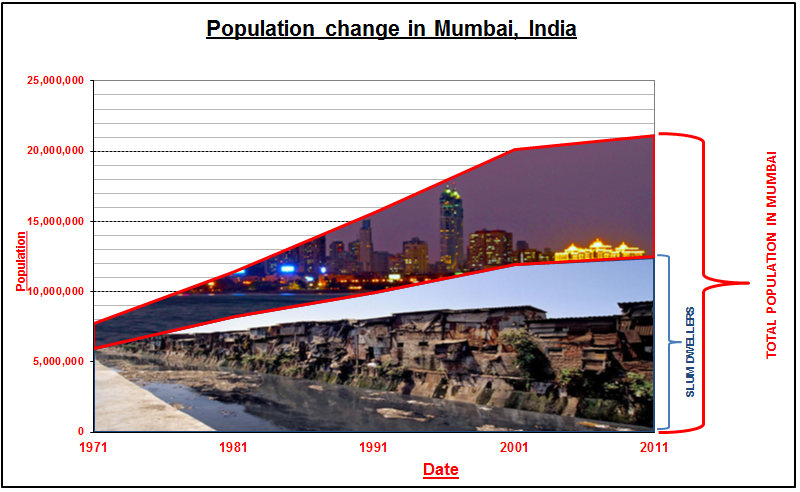
Since 1971, the graph shows the
inexorable rise in the population of Mumbai,
from 8 million in 1971 to 21 million now.
The other significant factor to note is
that slum dwellers make up an ever increasing
proportion of the population, creating numerous
problems for people and planners.
It should be noted that the original
urbanisation phase of Mumbai focussed upon the
southern tip of Salsette Island, and outside of
this the city suburbanised in a Northern
direction.
The causes of urbanisation
are multiple, but involve a high level of
natural increase within Mumbai itself and
in-migration principally from the surrounding
district of Maharashtra but also from
neighbouring states. Mumbai booming economy
means that migrants come for job opportunities
in the expanding industries, financial
institutions and administration.
Mumbai has grown in a Northern direction limited by physical Geography as shown in the image below. It is limited in where it can grow with creek systems to the North and East, the Arabian Sea to the West and its harbour to the south East. Mangrove swamps further complicate the picture, and these marginal lands often form the location for the poorest people who live illegally in slums. One such slum is Dharavi, in the heart of Mumbai.

The following notes are based upon Kevin McCloud's "Slumming it." And show the consequences
of rapid urbanisation in poorer countries, where
the pace of urbanisation make it difficult to
maintain services essential for an acceptable
standard of living.
Episode
1
Episode 2
Dharavi slum is located in Mumbai (formally
Bombay) in India. India’s and Mumbai's biggest
slum is known as Dharavi. There are a million
people crammed into one square mile in Dharavi.
At the edge of Dharavi the newest arrivals come
to make their homes on waste land next to water
pipes in slum areas. They set up home illegally
amongst waste on land that is not suitable for
habitation. In the wet monsoon season these
people have huge problems living on this low
lying marginal land. Many of the people here
come from many parts of India as a result of the
push and pull factors of migration.
Conditions in the slum
In the slum people have to live
with many problems. People have to go to the
toilet in the street and there are open sewers.
Children play amongst sewage waste and doctors deal
with 4,000 cases a day of diphtheria and
typhoid.
Next to the open sewers are water pipes,
which can crack and take in sewage. Dharavi slum
is based around this water pipe built on an old
rubbish tip. The people have not planned this
settlement and have no legal rights to the land.
There are also toxic wastes in the slum
including hugely dangerous heavy metals.
Dharavi
is made up of 12 different neighbourhoods and
there are no maps or road signs. The further you
walk into Dharavi from the edge the more
permanent and solid the structures become.
People live in very small dwellings (e.g.
12X12ft), often with many members of their
extended families.
Many architects and planners claim
this slum could hold the solution to many of the
problems of the world’s largest cities.
Water is a big problem for
Mumbai's population; standpipes come on at
5:30am for 2 hours as water is rationed. These
standpipes are shared between many people.
Rubbish is everywhere and most areas lack
sanitation and excrement and rats are found on
the street. 500 people share one public latrine.
The famous cloth washing area also
has problems, despite its social nature sewage
water filters into the water used for washing
clothes.
The Positives of Dharavi Slum
There are positives; informal
shopping areas exist where it is possible to buy
anything you might need. There are also mosques
catering for people's religious needs.
There is a pottery area of Dharavi
slum which has a community centre. It was
established by potters from Gujarat 70 years ago
and has grown into a settlement of over 10,000
people. It has a village feel despite its high
population density and has a central social
square.
Family life dominates, and there
can be as many as 5 people per room. The houses
often have no windows, asbestos roofs (which are
dangerous if broken) and no planning to fit fire
regulations. Rooms within houses have multiple
functions, including living, working and
sleeping.
Many daily chores are done in
social spheres because people live close to one
another. This helps to generate a sense of
community. The buildings in this part of the
slum are all of different heights and colours,
adding interest and diversity. This is despite
the enormous environmental problems with air and
land pollution.
85% of people have a job in the
slum and work LOCALLY, and some have even
managed to become millionaires.
Recycling
and waste in Dharavi
Kevin McCloud found that people seemed genuinely happy in the slum.
However, toilets are open holes above a river –
hardly hygienic. This could lead to Dengue
fever, cholera and hepatitis
Dharavi has a recycling zone. It is claimed that Dharavi’s recycling zone
could be the way forward to a sustainable
future. Everything is recycled from cosmetics
and plastics to computer keyboards. 23% of
plastic waste gets recycled in the UK, in Mumbai
it is 80%. However, it is humans who work to
sift the rubbish in the tips where children and
women sift through the rubbish for valuable
waste. They have to work under the hot sun in
appalling conditions. They earn around a £1 a
day for their work.
At the edge of the tip the rag dealers sort their haul before selling it
on to dealers. The quandary is that people have
to work in poor conditions to recycle waste.
From the tip it arrives in Dharavi where it is
processed. It is sorted into wire, electrical
products, and plastics. Plastics in India are
continuously recycled. People work in dangerous
conditions with toxic substances without
protective clothing; this could affect people’s
life expectancy. Even dangerous hospital waste
is recycled.
One private enterprise makes the metal cages inside suitcases, making 700
pieces per day, paid 3 rupees per piece. There
are 15,000 one room factories in Dharavi which
there are 300 feeding most of Mumbai. Many of
the products from Dharavi end up around the
world based upon very cheap labour. Many of the
people work in very poor working conditions, and
includes children. Indeed, Dharavi is trying to
do in 20 years what the west did in 200,
develop.
Managing and improving
Squatter settlements
Large scale redevelopment
A $2billion development project threatens the recycling district and part
of Dharavi. The land upon which Dharavi is built
is next to Mumbai’s financial district. This
makes it a prime target for redevelopment. The
people who are relocated will be put into
smaller housing in apartment blocks. An ancient
fishing village is also threatened. These areas
have strong safe neighbourhoods that have low
crime and communal areas. Also at risk are the
local shops and markets and the community spirit
which has taken generations to develop. The
locals would prefer small improvements to the
existing slum such as improvements in drainage.
The value of land is so high that redevelopment
is now a real threat. The alternative
accommodation is very small.
The slum dwellers face 14 story apartments as accommodation as proposed by
the cities Slum Rehabilitation Authority. This
will separate communities and make people work
away from where they live. Only people who have
lived in the slum since 2000 will be relocated.
Current redevelopment projects are densely
populated and house lots of people. They are not
good for community cohesion.
Local Based Improvements
There is an alternative to large scale redevelopment and that is to allow
LOCAL people design the
improvements to the slum.
The Society for
the Promotion of Area Resource Centres, better
known as SPARC, this is an NGO that supports the
efforts of local people to get better housing
for their many members. Ideas generated from
local people supported by this charity include
adding an extra floor to buildings so that all
family members can be accommodated in the same
building. These flats also had 14-foot high
ceilings and a single tall window so are well
ventilated, bright, and less dependent on
electric fans for cooling. Their loft spaces add
extra room without seeming crowded, and include
small spaces for bathing. But toilets are placed
at the end of each of the building’s four
floors, and kept clean by the two or three
families who use each one. These ideas only work
when water is running in Dharavi.
Architecture
students have also been hard at work. One
student has created a multi-storey building with
wide outer corridors connected by ramps “space
ways in the sky,” to replicate the street. These
space ways allow various activities to be
linked, such as garment workshops, while
maintaining a secluded living space on another.
Communal open space on various levels allows
women to preserve an afternoon tradition,
getting together to do embroidering.
One student also
tried to help the potters of Dharavi. He
designed into existing houses the living space
at one end and a place to make the pots at the
other. Each has an additional open terrace on
which to make pots, which are fired in a
community kiln.
As the National
Slum Dwellers Federation has repeatedly proven,
housing the poor works best, costs less and is
better for the environment, when the poor
themselves have a say in what is being built.
Dharavi could also follow the Brazilian model, as evidenced in Rocinha in
Rio de Janeiro. Within the Favelas the
government has assisted people in improving
their homes. Breeze blocks and other materials
(pipes for plumbing etc) were given as long as
people updated their homes.
This is
an approach known as SITE and SERVICE.
The Brazilian government also moved a lot of people out of shanty towns
and into low cost, basic housing estates with
plumbing, electricity and transport links. The
waiting list for these properties was huge.
Mumbai now has a long history of suburbanisation, and
many key events have occurred in the
suburbanisation process, initially in a
Northwards direction along major transport
routes such as roads and rail links, and now in
an Eastward direction.
This suburbanisation has involved not
just the growth of residential areas but also
the relocation and growth of new industrial
areas.
|
1930s to 1940s |
The rise of Shivaji Park area, Matunga and Mahim as the outlying
suburbs |
|
1960s (post independence) |
Inner suburbs in southern Salsette and Chembur-Trombay had emerged |
|
1970s |
Assimilation of the `extended suburbs' beyond Vile-Parle and Ghatkopar. |
As with other major cities, other towns and villages have been swallowed
up by Mumbai in the process of suburbanisation.
In the last decade, Thane, Vashi and Belapur
have become extended suburbs despite being
planned as individual towns. All of these
developments are summarised in the map below.

The northwards movement along rail and road corridors comes first.
Next, the areas around these
communication links are developed.
Third, these areas extend outwards and
can involve reclaiming land next to creeks and
mangrove, and slopes in the hills of Salsette
can be colonised too. The major railway stations
have areas around them that have become shopping
fronts. The reclaimed areas house the wealthier
middle and upper classes, but poorer people will
build huts in and amongst these areas and full
shanties can grow on the poorest quality land.
This suburbanisation has had consequences;
1.
People are economically stratified into those
that can afford better housing and those that
cannot, rather than historical caste, religious
or linguistic stratifications
2.
Less than a third of the population of Mumbai
lives in the `island' city.
3.
The centre of density of population has shifted
from the island city well into suburban Salsette.
4.
The commuter traffic has changed.
Rather than being just one way into the
Central Business District (CBD) in the south of
the city in the mornings there is an increasing
movement of people in the opposite direction.
Increasing industrialisation of the suburbs is
increasing this movement.
The map below shows that
some of the population of Mumbai is also
counterurbanising, with a decline in population
over a 20 year period within the original heart
of the city in Mumbai district.
The largest growth is in those districts
directly to the East of Salsette Island, and
even districts 50 or more kilometres from Mumbai
are growing.
One such phenomenon fuelling this growth
is that of planned towns (new towns in the UK.
Navi Mumbai is a planned township
directly to the East of Mumbai and was
designated in 1972.
It is the largest new town in the world.
The town was developed to reduce
congestion and population densities in Mumbai,
which itself was restricted by its physical
geography.
The new town now has a population of
1,111,000 people, is linked to Mumbai by road
and rail bridges and an international airport.
It also has an extensive bus network, an
international airport and many IT and software
firms in areas such as
the International Infotech Park at Vashi and the
New Millennium City near Mahape.

Reurbanisation – changes to Dharavi Slum
Large scale redevelopment
A $2billion development project threatens the recycling district and part
of Dharavi. The land upon which Dharavi is built
is next to Mumbai’s financial district. This
makes it a prime target for redevelopment. The
people who are relocated will be put into
smaller housing in apartment blocks. An ancient
fishing village is also threatened. These areas
have strong safe neighbourhoods that have low
crime and communal areas. Also at risk are the
local shops and markets and the community spirit
which has taken generations to develop. The
locals would prefer small improvements to the
existing slum such as improvements in drainage.
The value of land is so high that redevelopment
is now a real threat. The alternative
accommodation is very small.
The slum dwellers face 14 story apartments as
accommodation as proposed by the cities
Slum Rehabilitation
Authority. This will separate communities and make people
work away from where they live. Only people who
have lived in the slum since 2000 will be
relocated. Current redevelopment projects are
densely populated and house lots of people. They
are not good for community cohesion. Indeed, the
planned redevelopment is part of the Maharashtra
state governments plan for Dharavi.
The architect employed to put together a $2 billion
bid from major developers across the world to
demolish Dharavi and build homes and amenities,
Mukesh Mehta, has said
‘Dharavi is a black
hole – something we should be ashamed of. My
vision would be that it would be transformed
into one of the better suburbs of Mumbai.’
The residents do not want this redevelopment,
Arputham Jockin grew up in Mumbai's slums and now
represents the slum dwellers in their fight
against the government's plans.
‘Selling
this land to the global market and giving it
over for commercial use - how will that improve
our lives? 90% of the people here want a stake
in their future and a say in how it is
transformed. It has to work from the bottom up -
not top down.’
he says.
As
of 2012 no progress had been made with the plans.
View Mumbai Location Map in a larger map

Coolgeography.co.uk by Rob Gamesby is licensed under a Creative Commons Attribution-NonCommercial 3.0 Unported License.
Contact -
robert.gamesby@st-marys.newcastle.sch.uk
Contact via Google Docs form