



MEDC case study – Newcastle Upon Tyne,
NE of England
Background to Newcastle
Counterurbanisation in Newcastle
Reurbanisation
– changes to Newcastle – upon -Tyne
Newcastle-upon-Tyne is a large city in
the Northeast of England that exhibits all of
the characteristics of this World Cities Unit.
It has both evolved over
long periods of time but has also had major and
tumultuous revolutions that have been both
positive and negative.
(recall that this unit
is called World Cities: Evolution or
Revolution). It is the largest city in North
East England, has a very large sphere of
influence, forms a major part of the Tyne and
Wear conurbation and has been classified as a
High Sufficiency city by the
Globalization and World Cities (GaWC)
Research Network.
This means that it is a
city
with sufficiency of services so
it is not a world city
but has sufficient services so as not to be
overtly
dependent on world cities.
This case study includes information
found on other pages within the website, and
aims to collate these together.
It also takes a local
look at how Newcastle has repeatedly attempted
to combat the impacts of Urban Decline.

URBANISATION PROCESSES
Urbanisation and suburbanisation
Newcastle upon Tyne is situated on the
north bank of the River Tyne and was once part
of the county of Northumberland. It owes its
original location to the Romans, who established
Pons Aelius. Initially the city was a great
defensive site up on a valley side, which had
fresh water in the Tyne and is a bridging point.
It grew because of the
wool trade but is really famous for being a
major coal mining area. The port developed in
the 16th century and, along with the shipyards
lower down the river, was amongst the world's
largest shipbuilding and ship-repairing centres.
The coal industry
developed from 1530 after a royal law was
passed, and by the 18th century, Newcastle was
the country's fourth largest print centre after
London, Oxford and Cambridge. In the 19th
century, shipbuilding and heavy engineering were
central to the city's prosperity; and the city
was a powerhouse of the Industrial Revolution.
Innovations included the development of safety
lamps, Stephenson's Rocket, Lord Armstrong's
artillery, Be-Ro flour, Joseph Swan's electric
light bulbs, and Charles Parsons' invention of
the steam turbine, which led to the revolution
of marine propulsion and the production of cheap
electricity. These developments encouraged the
growth of Newcastle, and this involved rapid
urbanisation and suburbanisation.
The wealthy tended to
migrate to the North of city away from the heavy
industries of the river, and the city
suburbanised in this direction and continues to
do so today.
Major suburbs include
Gosforth, Jesmond and more recently Newcastle
Great Park.
Gosforth contains its
own high Street and a population of around
24,000 people.
It is a good example of
outward expansion of a city and electoral ward
boundary changes allowing a city to swallow up
an independent town, this happened in 1974.

The council also helped in this process
as they constructed edge of town council estates
in Longbenton and Kenton.
Industry has followed in
this suburbanisation pattern, with new light
industrial centres and office developments at
Quorum, Newcastle Great Park and at Silverlink
along the A19.
The urbanisation process
took place East and West along the river, and
this gave rise to inner city developments of
Wallsend, Walker and Benwell.
All of these
developments have their own characteristics,
showing that not all suburbs are the same.
The recent suburbanisation of Newcastle
northwards with the development of Newcastle
Great Park into the Greenbelt originally
designed to limit the cities growth shows that
suburbanisation has not finished.
You can read more
about this development here.
The city's last coal pit closed in 1956. This was followed by the slow demise of the shipyards on the banks of the River Tyne in the 1970s, 1980s and 1990s. The riverside areas of Newcastle upon Tyne were responsible for the cities incredible growth and wealth during the industrial revolution. Heavy industries such as the Armstrong armaments works and ship building (e.g. Swan Hunters) employed tens of thousands of people from riverside communities in Newcastle such as Elswick and Scotswood. Overseas competition in these industries in the 1960s, 70s and 80s led to the decline and closure of these industries and the communities suffered as a result. Manufacturing employment in conurbations like Newcastle fell nationally by nearly 20% in the 1960s and collapsed by 35% in the 1970s, amounting to 1.6 million jobs lost altogether (Source - http://www.jrf.org.uk/system/files/1861347685.pdf ).
By the mid-1970s, employment at the
Vickers factories along the West Newcastle
riverside had fallen to little more than 3,000 –
less than 16% of the previous wartime figure.
The Vickers Scotswood works closed altogether in
1979. During the last two years of the 1970s,
almost 1,500 jobs were lost from the eleven
biggest local employers – representing a decline
of 22% – and two of these eleven had closed
altogether.
(Source
-
http://archiveforchange.org/decades/1970s/).
This led to population losses in many industrial
parts of Newcastle, whilst surrounding suburbs
and satellite towns, such as Whitley Bay and
Cramlington New Town gained in population.
The inner city and CBD
also started to come under pressure from other
forms of retailing, such as the Metrocentre inn
the early 1980s.
The Metrocentre has 10,000 free parking
spaces and accessibility for shoppers, the
Metrocentre also has its own junction of the A1
west of Gateshead.
The net result can
clearly be seen on the graph of Newcastle’s
population, which declined rapidly and had a
negative effect on people, the environment and
the economy resulting in a cycle of decline for
many parts of the city.
As described above
inner Cities in Britain in the 1970s started to
decline, mainly as a result of the loss of their
industries (deindustrialisation). This
deindustrialisation led to many problems such as
high unemployment, the development of
ghettoes,
low morale and self-esteem of the local
population, decline in the environment, decline
in the housing stock. Many industries and people
moved out of the inner city to the suburbs. One
such area that suffered decline was Newcastle
upon Tyne and many different schemes have been
attempted to try and increase the population and
economy of the city in the process of
reurbanisation.
PROPERTY LED REGENERATION -
The Tyne and Wear Development
Corporation (TWDC)

The TWDC was an urban development
corporation (UDC) set up by the UK government.
UDCs are property-led regeneration which
are run by an executive board and are given
money by central government and their aim is
always to improve the area in such as way as
businesses will see it as a good business
opportunity. They are market led and property
led because they make physical changes, e.g.
improve infrastructure to attract businesses
(property led) and it is market forces not
planners, that decide the ultimate layout of the
area – they want businesses to lead the way
(market led). So the
Tyne and Wear Development Corporation
(TWDC)
is an example of
large scale regeneration
and its basic aims were to;
Create new business districts or modern
offices and industrial estates
Increasing employment through grants and
training
Reviving riversides as a place to live
Improving environment and landscaping

Set up in 1987 in the second wave of
UDCs, TWDC’s task was to bring land and
buildings back into effective use in its
designated area and encourage the development of
existing and new industry and commerce. Its area
covered 26 miles of riverside along the Tyne and
Wear rivers and spanned the four local authority
areas of Newcastle, North and South Tyneside and
Sunderland. One-third of its area was derelict,
polluted or under-used.
Funding
-
£430 million of government money
attracting £1,114 million of private sector
money.
The government money
went into funding improvements to the
infrastructure and public realm of the areas
located on the map.
This then encouraged
private firms to join in.
The TWDC was very
successful in this and its major projects were
mainly
Flagship projects including:
Newcastle Business park
- £140 million development of 25ha of offices on
previous derelict land British Airways have
offices there.
The Copthorne hotel was built at a cost
of 30 million
£2 million to transform 10 major historic buildings along the Quayside

Newcastle quayside – cost £170 million
St Peters Basin transformed into a major
housing development

Newcastle and
Gateshead Quayside from the Castle Keep -
TWDC has transformed the Newcastle
Quayside but has been less successful at
regenerating housing estates. Many local
communities had to be relocated to make way for
the big developments despite the UDCs attempts
to use a Community Development Strategy.
This committed it to supporting,
informing and consulting local communities and
community groups. It covered activity across
different policy areas: training, employment,
social housing, environmental improvements, arts
and cultural activities, and recreation and
leisure facilities especially relating to the
rivers and riversides. It helped to put 2000
local people into jobs in the Royal Quays
Employment Office and 25% of the houses it built
were low cost.
However, the TWDCs use
of compulsory purchase orders, focus on service
sector and managerial posts rather than ,
manufacturing and focus on predominantly
expensive housing has been criticised.
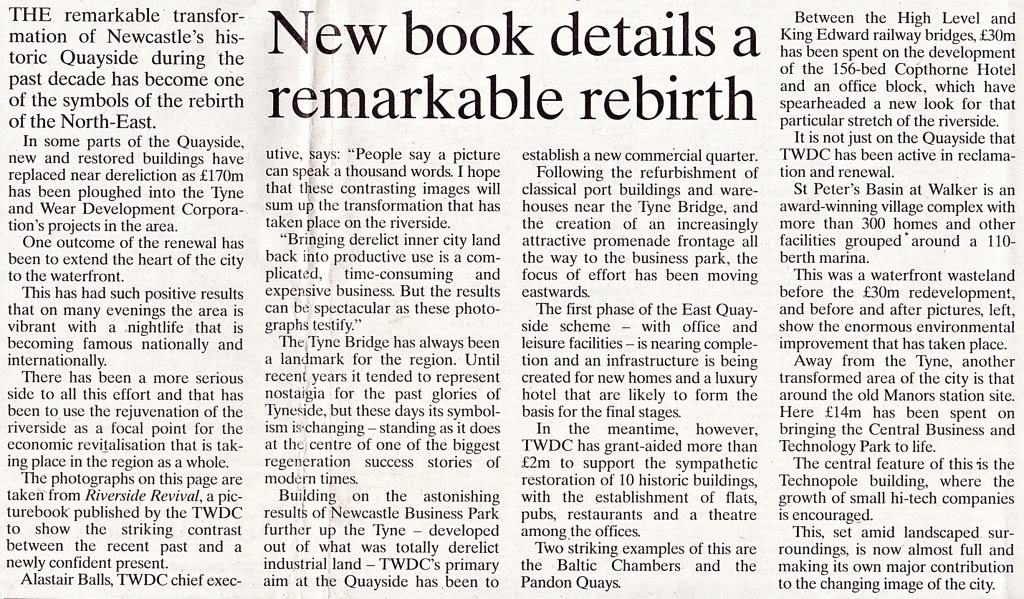
This newspaper article, from the
Journal
of Wednesday February 14th 1996, reveals that
these areas were all transformed during the era
of the Tyne and Wear Development Corporation.
PARTNERSHIP SCHEMES BETWEEN LOCAL AND
NATIONAL GOVERNMENTS AND THE PRIVATE SECTOR –
Grainger Town
Urban regeneration: gentrification,
property-led regeneration schemes, partnership
schemes between local and national governments
and the private sector.

Newcastle is a fantastic city for
architecture and much of it is conserved. The
most architecturally beautiful area is Grainger
town, where Grey Street and the Theatre Royal
can be found. These areas have been subject to a
multi million regeneration project that involved
redeveloping the interiors of many buildings,
cleaning the sandstone on Grey’s monument and
the Theatre Royal and bringing empty shops back
into use. Many of the buildings in Grainger Town
are protected as Listed Buildings, and as such
cannot be altered.
Indeed, Grainger Town is
a historic town in
the heart of Newcastle-upon-Tyne.
40% of the buildings in
the area are listed as being of historical and
architectural importance.
The Grainger Town area covers 90 acres
between Central Station and Northumberland
Street, encompassing Grainger’s new buildings,
Medieval streets like the Bigg Market and
Victorian buildings too. In addition the
13th
century Dominican Friary
of Blackfriars and remnants of the old Town Wall
gives Grainger Town a great richness of
character. Commercial ground floor properties
consisting of shops sit beneath offices and
residential properties in terraces with some
landmark buildings such as the Theatre Royal.
Historical development:
Grainger Town is a historic part of
Newcastle City Centre which has had 3 major
periods of Urban Change. The initial phase
replaced old mediaeval parts of they town with
new street layouts and buildings from 1835 to
42; a major decline phase from the 1960s to
1990s and its current regenerated phase.
1835 to 42
– Richard Grainger
developed a series of classical streets
1835 and 1842 which are overlaid on the pattern
of the medieval settlement that was there
before.
Grainger was lucky in
that Newcastle was unusual as there was a large
property – Anderson Place – with extensive
grounds within the city walls. Grainger’s idea
was to link the smart residential areas to the
north with the cramped trading district above
the quayside.

1960s to 1990s
-
parts of Grainger Town were demolished
to make way for projects such as the Eldon
Square and parts of the area were overtaken by
others as centres for commerce and retail. By
the 1990s the decline inn the are was at its
worst with;
-
Shops and offices moved
out to other locations
-
Residential population
of the area was falling rapidly
to 1,200
-
100,000 m² of floor
space vacant
-
Investor confidence was
low
-
Structural problems
became evident with 47% of its
244 listed buildings classed as
being 'at risk' and a further
29% classified as vulnerable
1993
– English Heritage and Newcastle City council
launched a programme of property development and
environmental improvement which helped the most
at risk buildings and began to stop the decline
of the area.
1996
-
Newcastle City council,
the English Heritage and English Partnerships
decided that the area could no longer be left to
take care of itself and prepared a bid for
government funding for a regeneration strategy
1997
-
Grainger Town Project established – a
partnership with Newcastle City Council, English
Partnership and English Heritage. £40 million of
public sector investment was expected to be
bolstered by a further £120 million from the
private sector, but the latter reached £160
million.
2003
– The project was finished to be overseen by the
now defunct One NorthEast
Elements of the project:
The original vision of the Partnership
was that - “Grainger Town will become a dynamic
and competitive location in the heart of the
City. Grainger Town will develop its role in the
regional economy with a high-quality environment
appropriate to a major European regional
capital. Its reputation for excellence will be
focused on leisure, culture and the arts,
retailing, housing and entrepreneurial
activities.
Grainger Town will become a distinctive place, a
safe and attractive location to work, live and
visit.”
The achievements of
the regeneration of Grainger Town include:
-
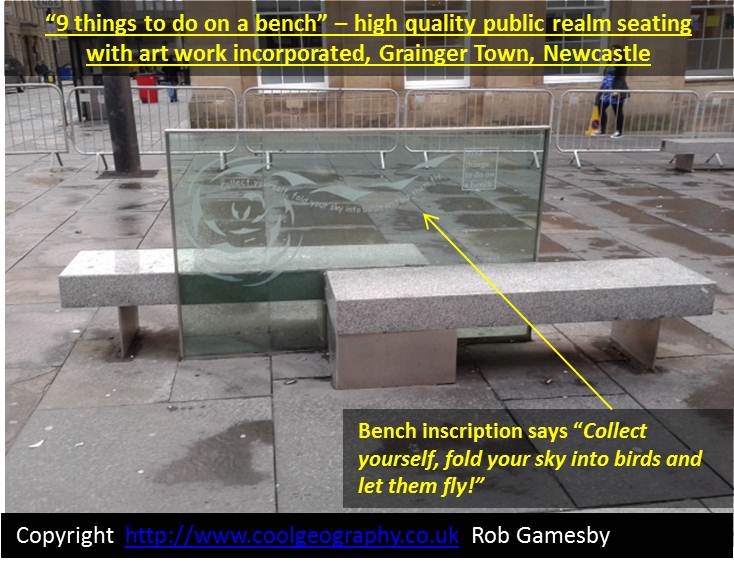
The public realm was
also Improved, using high
quality stone and public art
-
1506 jobs created as
well as a further 800 in
Grainger Town due to the
increased confidence in the
area.
-
286 new businesses set
up.
-
80,900 m² of new and/or
improved commercial floor space.
-
121 buildings, many of
them listed properties and
classified as 'Buildings at
Risk' restored for use.
-
Grey's Monument
repaired and cleaned.
-
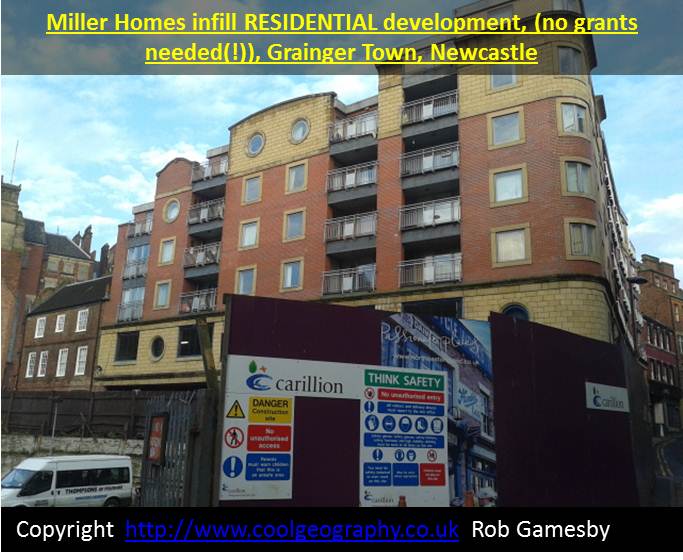
289 flats and apartments
completed with many located
within the Grainger Street and
Clayton Street areas.
-
Westgate House,
which was an eleven storey
office block, perhaps
Newcastle’s most unpopular
building, was acquired by ONE
North East and demolished
between late 2006 and early
2007.
Source of
achievements -
http://en.wikipedia.org/wiki/Grainger_Town
Case study -
The Union Rooms
- The former Union Club in Westgate Road, a
Listed Victorian building lay empty for over 20
years in spite of its grand staircase and
impressively-sized rooms and its location close
to Central Station. The 22,000 sq. ft. building
has recently been renovated and converted into a
pub/restaurant/wine bar, which occupies the
three lower floors, by the J D Wetherspoon
chain. There is also space for up to 7 flats on
the top two floors.
Although the original building contained
much wasted space, and vandalism and dry rot had
caused extensive damage, the renovation has
largely followed the original design.
The spacious, high-ceilinged rooms have
been retained; the stone staircase and the cast
iron dome have been restored; the plasterwork,
fireplaces, stained glass and other details have
been replaced to match what was previously
there. The total cost of the project was £4.2
million, but the result is a great success.
This project has been followed by
others, not least the Science City development -
http://www.newcastlesciencecity.com/
.

GENTRIFICATION
Gentrification is
the
buying
and renovation of houses
and
stores in deteriorated urban neighbourhoods by
upper- or
middle-income
families
or
individuals, thus
improving property values but often displacing
low-income
families
and
small
businesses.
It can also be attempted by businesses and local
councils.
NCC – Gentrification of tower blocks
Ouseburn and the Toffee Factory

Source: Paul J White, available at:
http://www.flickr.com/photos/pauljw/4502542375/in/set-72157623681068575


Forth Street Gentrification -
The railway viaduct arches provide
spaces for these modern retail premises. In
former years they were occupied by small
engineering works and motorcycle sales and
repair businesses. Gentrification proceeds
apace.


Coolgeography.co.uk by Rob Gamesby is licensed under a Creative Commons Attribution-NonCommercial 3.0 Unported License.
Contact -
robert.gamesby@st-marys.newcastle.sch.uk