



Economic development and change related to
urbanisation.
MEDCs in the World’s economic core have experienced Urbanisation for hundreds of years. In the UK, this was largely following the Industrial Revolution in late eighteenth and early nineteenth centuries. In addition, population densities in MEDC cities tend to be lower than in the developing world. Growth in cities in developed world cities has either stabilised or some cities have even gone into decline.
Urbanisation is
a more recent arrival in LEDCs and NICs. The
growth over the past fifty years of many
developing world cities has had major
implications for the people living there and the
management of those issues. NICs (Newly
Industrialising Countries) have urbanisation
that takes place with rapid industrialisation,
as has been witnessed in Brazil and South
Eastern China, whilst in some LDCs (Least
Developed Countries) urbanisation takes place in
the relative absence of industrialisation,
people forced to cities to live in poor
conditions with limited opportunities for jobs.
Indeed, we must
consider to what extent are the two processes of
urbanisation and industrialisation mutually
dependent?
In cities in the UK industrialisation went hand
in hand with urbanisation, as evidenced by the
coal and then shipping industry in
Newcastle-upon-Tyne fuelling the growth of the
city.
Lancashire had huge growth in its towns
around mills, towns such as Blackburn and Bolton
owe their growth to this industry.
Middlesbrough grew up around the steel
industry, ship building and petro chemicals.
Indeed,
Britain is a great example of a place that
exemplifies the link between industrial growth
and decline, and urbanisation.
The map below shows the recent decline of
many of the places mentioned above.
The movement of heavy industry and
textiles to other countries that can produce
goods more cheaply has resulted in the
deindustrialization of many urban areas
particularly in the North of England, and
population levels have fallen as a result.
Most of the growth of settlements in
Britain is found in settlements further South,
or in places that have active high technology
industries and services industries such as
Edinburgh.

However, many places grow without
industrialisation, and many people end up as
slum dwellers.
Greg Hoare notes that “There
were more than one billion slum dwellers in 2005
(even using the UN’s most restrictive
definition). There are probably more than
200,000 slums on earth, ranging in population
from a few hundred to more than a million
people. Slum populations, according to the UN,
are currently growing by a massive 25 million
each year. In 2003, China had 194 million and
India 158 million slum dwellers; the USA had
12.8 million. A third of the global urban
population live in slums. In the least developed
countries, this figure stands at four in five.”
Source
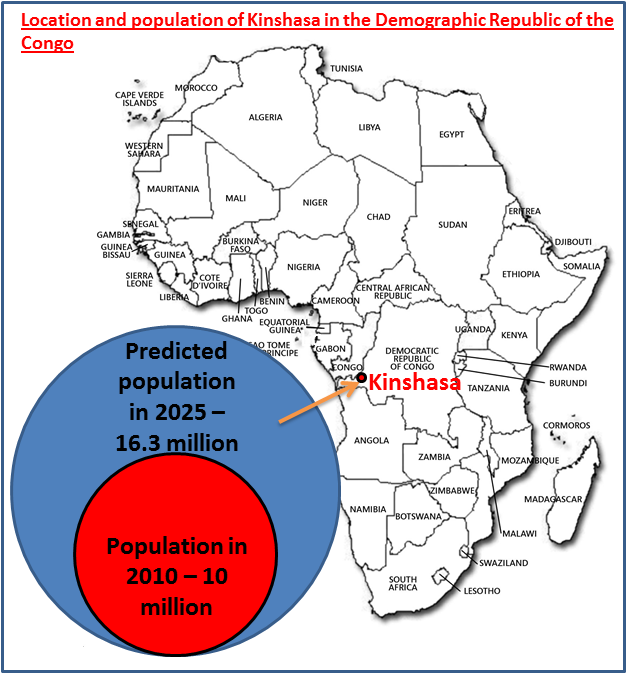
For example, Kinshasa in the Congo has a
6.29 million predicted
increase in population by 2025.
Its
current population (2010) is over 10 million, up
4 million since 2001.
It
is a sprawling megacity
in the Democratic Republic of Congo and is ill
prepared for its place as one of the world's
fastest-growing cities. That's because Kinshasa
is still rooted in the primary economic sector,
trading in natural resources
(copper, cobalt, diamonds, gold, zinc,
and other base metals)
that are quickly being depleted.
Aside from the city's
lack of preparedness, violence is a daily
occurrence in Kinshasa, as the entire nation
reels from years of lawlessness and civil war.
This has swelled the growth of the city over
recent decades, as people flee to the city,
again, urbanisation in the absence of
industrialization for many of the residents of
Kinshasa. A dangerously high crime rate is
poised to keep rising as the disparity between
rich and poor continues to increase. Housing
takes the form of sprawling slums,
infrastructure is hardly maintained, and civil
services in Kinshasa are virtually nonexistent —
all of which means the city will need to make
huge strides to bolster the weight of its
expanding population. (source)