



CAP
Original aims
MacSharry Reforms

Complete this Opinion line exercise.

CAP
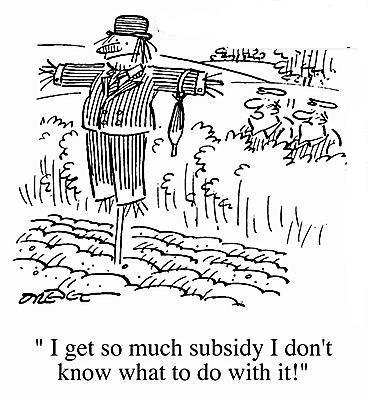
The original aims of CAP were as follows;
To raise food production levels across the European Union
To keep European agricultural market stable
Keep food prices stable and fair in Europe
To maintain agricultural employment in the European Union
To maintain Farmers incomes across the Union.
Some of these aims are clearly contradictory, because if improvements in technology means mechanisation then people will lose jobs, thereby lowering agricultural employment!
The aims of CAP were met through mainly protectionist measures (see Geopolitics section) and they included;
| Guaranteed prices and intervention buying - where farmers were guaranteed a minimum rice fore their product and if they could not sell the product on the open market the EU would buy the product from them. This was designed to stop the impacts of price fluctuations and allow income security for farmers. | Export and production Subsidies - where farmers were paid money on exporting their product so that it could be sold at a cheaper price on the World market. This allowed EU goods to undercut the price of other countries, a massive benefit to EU farmers. Production subsidies also encouraged farmers to produce food stuffs that the EU decided was in short supply, so the EU could control what was grown to meet demand. | Import Tariffs were taxes placed on foreign goods from outside of the EU, to raise their price relative to the EU products. This meant that EU consumers would choose cheaper EU products. | Investment grants were available to commercialise agriculture. The goal was to allow small farmers to amalgamate their small holdings in to bigger units so that they were more productive and could take advantage of economies of scale. Grants were also available for investment in fertilisers and machinery to improve technology levels in agriculture. |
The impact of all of these policies was to massively raise production across the EU and to force small holders out of farming. Bigger and more competitive farms simply bought out smaller less economic holdings. Farmers became so productive that in the 1970s news stories hit the press about European Butter and grain mountains, wine lakes and Olive oil excesses. The EU had to pay out lots of money to store this food and also courted controversy because the excesses were used as food aid or dumped on poor countries markets at massively reduced prices. This undercut local farmers in poor countries and removed their markets. To control these excesses the EU had a quota system where farmers could only produce a certain amount of a produce or face a fine. However, it was clear that by 1990 that the CAP needed changing, despite vocal protest from agricultural EU nations which had benefitted massively from CAP such as Greece, Italy, Spain and France. The General Agreement on Tariffs and Trade also deemed subsidies to be against the spirit of Free Trade. The CAP absorbed a huge proportion of the EU's budget and led to the intensification of farming using chemical fertilisers, pesticides and insecticides. It also massively increased the energy use and hence carbon footprint of farms. The use of chemicals sparked fears of a "Silent Spring", with fears over widespread pollution of water courses, chemical residue on food stuffs and eutrophication.
The MacSharry reforms (after Ray MacSharry 1992) sought a much more environmental and lower intensity type of farming. Some of the main policies are;
The removal of price support to bring grain meat and dairy prices closer to world prices.
Set a-side - farmers were paid to not produce on 10% of their land to reduce production and allow for nature conservancy.
Environmental stewardship - a case study can be found by clicking here.
The slow removal of subsidies - this was for all sectors of farming, and has hit dairy and meat producing farmers in marginal areas (such as British hill farmers) hardest.
Money was redirected to Eastern Europe so that they could adjust to the EUs market economy
In 1993 the General Agreement on Tariffs and Trade (GATT) meant that even these reforms did not go far enough, and that the EU must falling line with the rules of international trade. In other words, the PROTECTIONIST system used by the EU was wrong and would have to stop. The GATT also demanded the decoupling of financial aid from food production.
The new reforms then had 9 aims;
Decrease the use of artificial fertilisers
Increase organic production
Encourage Extensive forms of agriculture
Maintain "environmental goods" in the form of woodlands, wetlands and heath lands
Decrease stock intensities of sheep and cattle
Maintain abandoned farmland and woodland
Encourage breeding of endangered and local breeds
Encourage long term set-aside of land
Increase public access to recreational use of the countryside.
